
Vadodara is widely recognized as one of India’s premier industrial hubs, hosting major chemical plants, pharmaceutical manufacturing facilities, petrochemical refineries, and heavy engineering units. When fabrication projects demand high performance and corrosion resistance, selecting the correct grade of stainless steel is critical. Among the most common grades specified by engineers are 304, 304L, 316, and 316L. But what does that crucial extra 'L' stand for, and why does it make a difference when welding in Vadodara’s aggressive industrial environments? At Pooja Steel & Engineering, we supply premium-grade raw materials and custom-engineered components. Here is everything you need to know about these popular stainless steel grades to ensure your welded structures last. What Does the 'L' Stand For? The letter 'L' stands for 'Low Carbon.' Standard Grades (304 & 316): Contain up to 0.08% maximum carbon content. 'L' Grades (304L & 316L): Contain a maximum of 0.03% carbon content. While a difference of 0.05% carbon may seem negligible, it drastically alters the metallurgical behavior of the steel during and after high-temperature operations like welding. Why Low Carbon Matters: Understanding Sensitization and Weld Decay When standard stainless steel grades (like 304 or 316) are exposed to high welding temperatures—specifically between $425^circtext{C}$ and $860^circtext{C}$ ($800^circtext{F}$ to $1500^circtext{F}$)—the carbon combines with chromium to form chromium carbides along the grain boundaries. This process is called sensitization. The Consequence: Intergranular Corrosion (Weld Decay) Because chromium is the element responsible for forming a passive oxide layer that prevents rusting, carbide precipitation depletes free chromium near the weld seam. When exposed to corrosive fluids or humid industrial atmospheres: The localized depleted areas lose their corrosion resistance. Intergranular corrosion sets in along the Heat-Affected Zone (HAZ). Structural degradation or premature joint failure occurs—a defect known as weld decay. How 304L and 316L Prevent Weld Decay By reducing the carbon content to 0.03% or lower in 304L and 316L, chromium carbides cannot easily form during welding. This allows the material to retain its corrosion resistance right through the welded joint without requiring post-weld heat treatment (PWHT). Comparing the Grades: 304/304L vs. 316/316L To choose the right alloy for your project, it is essential to understand both carbon levels and chemical compositions. 1. 304 vs. 304L Composition: ~18% Chromium, ~8% Nickel. 304: Higher strength due to higher carbon content. Ideal for general structural applications, kitchenware, architectural fittings, and light chemical exposure where heavy welding is not required. 304L: Ideal for welded components operating in mildly corrosive environments. Widely used in dairy processing, beverage plants, and architectural structures across Vadodara. 2. 316 vs. 316L Composition: ~16% Chromium, ~10% Nickel, plus 2% to 3% Molybdenum. Why Molybdenum? Molybdenum provides significantly higher resistance to chlorides, pitting, and crevice corrosion compared to 304 series steels. 316: Excellent choice for chemical processing equipment where welding is minimal or post-weld annealing is feasible. 316L: The ultimate standard for welded assemblies in harsh environments. Essential for pharmaceutical manufacturing, marine equipment, acid handling, and petrochemical pipelines in Gujarat's industrial belts. Quick Comparison Summary Feature Grade 304 Grade 304L Grade 316 Grade 316L Max Carbon Content $0.08%$ $0.03%$ $0.08%$ $0.03%$ Molybdenum Added? No No Yes ($2text{–}3%$) Yes ($2text{–}3%$) Mechanical Strength Slightly Higher Slightly Lower Slightly Higher Slightly Lower Welding Suitability Needs PWHT for thick parts Excellent without PWHT Needs PWHT for thick parts Superior without PWHT Pitting Resistance Standard Standard High (Chloride resistant) High (Chloride resistant) Practical Applications in Vadodara's Key Industries Pharmaceutical Manufacturing: Facilities in Nandesari and Makarpura require ultra-clean environments. 316L is mandatory due to its resistance to sanitizing chemicals, smooth weldability, and resistance to pitting. Chemical & Petrochemical Refineries: High-temperature and acid-handling pipelines heavily depend on 316L to withstand corrosive media across welded joint lines. Food & Dairy Processing: Equipment for milk, beverage, and edible oil processing frequently uses 304L to maintain hygiene standards without risking weld decay. General Fabrication & Infrastructure: Non-corrosive structural frameworks, storage tanks, and decorative elements often utilize 304 or 304L depending on section thickness and joint design. Essential Welding Best Practices for 304L & 316L To maximize the service life of your welded stainless steel components: Select the Correct Filler Metal: Match low-carbon base metals with low-carbon fillers (e.g., ER308L for 304L, ER316L for 316L). Control Heat Input: Keep interpass temperatures low to minimize thermal stress and grain growth. Ensure Proper Back-Purging: Use argon purging gas when welding pipes or tanks to avoid oxidation ('sugarings') on the root side of the weld. Surface Cleaning: Always use dedicated stainless steel wire brushes and tools to prevent iron contamination. Partner with Pooja Steel & Engineering Choosing between 304, 304L, 316, and 316L depends on your specific operating temperatures, chemical exposure, and fabrication requirements. At Pooja Steel & Engineering, we stock a full range of high-quality stainless steel plates, pipes, fittings, and flanges with complete test certificates (MTC) to meet international standards. Need guidance for your next project in Vadodara? Looking for reliable suppliers of certified 304L or 316L raw materials? Contact Pooja Steel & Engineering today to speak with our material specialists or request a quote!


This is your website preview.
Currently it only shows your basic business info. Start adding relevant business details such as description, images and products or services to gain your customers attention by using Boost 360 android app / iOS App / web portal.
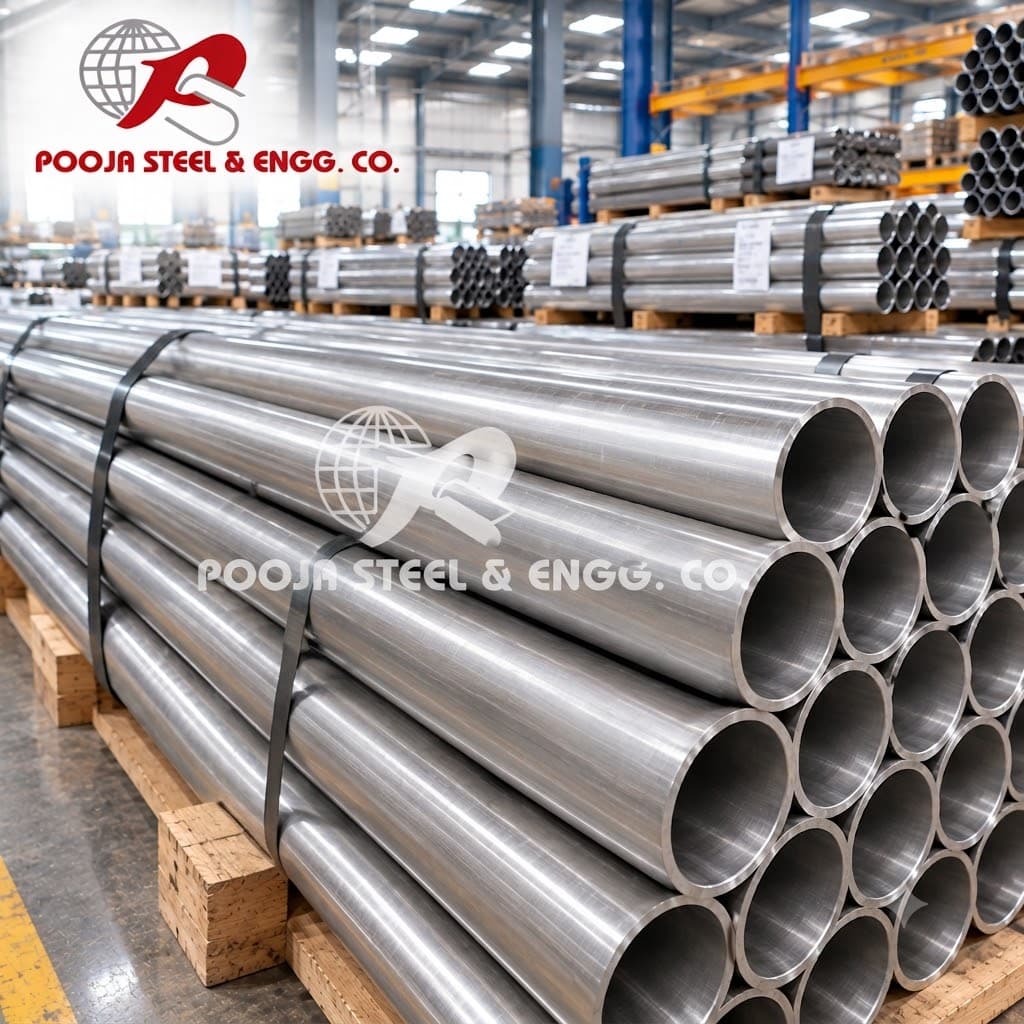
304 vs 304L and 316 vs 316L: What the 'L' Means for Welding in Vadodara
2026-11-02T11:09:43
Vadodara is widely recognized as one of India’s premier industrial hubs, hosting major chemical plants, pharmaceutical manufacturing facilities, petrochemical refineries, and heavy engineering units. When fabrication projects demand high performance and corrosion resistance, selecting the correct grade of stainless steel is critical. Among the most common grades specified by engineers are 304, 304L, 316, and 316L. But what does that crucial extra 'L' stand for, and why does it make a difference when welding in Vadodara’s aggressive industrial environments? At Pooja Steel & Engineering, we supply premium-grade raw materials and custom-engineered components. Here is everything you need to know about these popular stainless steel grades to ensure your welded structures last. What Does the 'L' Stand For? The letter 'L' stands for 'Low Carbon.' Standard Grades (304 & 316): Contain up to 0.08% maximum carbon content. 'L' Grades (304L & 316L): Contain a maximum of 0.03% carbon content. While a difference of 0.05% carbon may seem negligible, it drastically alters the metallurgical behavior of the steel during and after high-temperature operations like welding. Why Low Carbon Matters: Understanding Sensitization and Weld Decay When standard stainless steel grades (like 304 or 316) are exposed to high welding temperatures—specifically between $425^circtext{C}$ and $860^circtext{C}$ ($800^circtext{F}$ to $1500^circtext{F}$)—the carbon combines with chromium to form chromium carbides along the grain boundaries. This process is called sensitization. The Consequence: Intergranular Corrosion (Weld Decay) Because chromium is the element responsible for forming a passive oxide layer that prevents rusting, carbide precipitation depletes free chromium near the weld seam. When exposed to corrosive fluids or humid industrial atmospheres: The localized depleted areas lose their corrosion resistance. Intergranular corrosion sets in along the Heat-Affected Zone (HAZ). Structural degradation or premature joint failure occurs—a defect known as weld decay. How 304L and 316L Prevent Weld Decay By reducing the carbon content to 0.03% or lower in 304L and 316L, chromium carbides cannot easily form during welding. This allows the material to retain its corrosion resistance right through the welded joint without requiring post-weld heat treatment (PWHT). Comparing the Grades: 304/304L vs. 316/316L To choose the right alloy for your project, it is essential to understand both carbon levels and chemical compositions. 1. 304 vs. 304L Composition: ~18% Chromium, ~8% Nickel. 304: Higher strength due to higher carbon content. Ideal for general structural applications, kitchenware, architectural fittings, and light chemical exposure where heavy welding is not required. 304L: Ideal for welded components operating in mildly corrosive environments. Widely used in dairy processing, beverage plants, and architectural structures across Vadodara. 2. 316 vs. 316L Composition: ~16% Chromium, ~10% Nickel, plus 2% to 3% Molybdenum. Why Molybdenum? Molybdenum provides significantly higher resistance to chlorides, pitting, and crevice corrosion compared to 304 series steels. 316: Excellent choice for chemical processing equipment where welding is minimal or post-weld annealing is feasible. 316L: The ultimate standard for welded assemblies in harsh environments. Essential for pharmaceutical manufacturing, marine equipment, acid handling, and petrochemical pipelines in Gujarat's industrial belts. Quick Comparison Summary Feature Grade 304 Grade 304L Grade 316 Grade 316L Max Carbon Content $0.08%$ $0.03%$ $0.08%$ $0.03%$ Molybdenum Added? No No Yes ($2text{–}3%$) Yes ($2text{–}3%$) Mechanical Strength Slightly Higher Slightly Lower Slightly Higher Slightly Lower Welding Suitability Needs PWHT for thick parts Excellent without PWHT Needs PWHT for thick parts Superior without PWHT Pitting Resistance Standard Standard High (Chloride resistant) High (Chloride resistant) Practical Applications in Vadodara's Key Industries Pharmaceutical Manufacturing: Facilities in Nandesari and Makarpura require ultra-clean environments. 316L is mandatory due to its resistance to sanitizing chemicals, smooth weldability, and resistance to pitting. Chemical & Petrochemical Refineries: High-temperature and acid-handling pipelines heavily depend on 316L to withstand corrosive media across welded joint lines. Food & Dairy Processing: Equipment for milk, beverage, and edible oil processing frequently uses 304L to maintain hygiene standards without risking weld decay. General Fabrication & Infrastructure: Non-corrosive structural frameworks, storage tanks, and decorative elements often utilize 304 or 304L depending on section thickness and joint design. Essential Welding Best Practices for 304L & 316L To maximize the service life of your welded stainless steel components: Select the Correct Filler Metal: Match low-carbon base metals with low-carbon fillers (e.g., ER308L for 304L, ER316L for 316L). Control Heat Input: Keep interpass temperatures low to minimize thermal stress and grain growth. Ensure Proper Back-Purging: Use argon purging gas when welding pipes or tanks to avoid oxidation ('sugarings') on the root side of the weld. Surface Cleaning: Always use dedicated stainless steel wire brushes and tools to prevent iron contamination. Partner with Pooja Steel & Engineering Choosing between 304, 304L, 316, and 316L depends on your specific operating temperatures, chemical exposure, and fabrication requirements. At Pooja Steel & Engineering, we stock a full range of high-quality stainless steel plates, pipes, fittings, and flanges with complete test certificates (MTC) to meet international standards. Need guidance for your next project in Vadodara? Looking for reliable suppliers of certified 304L or 316L raw materials? Contact Pooja Steel & Engineering today to speak with our material specialists or request a quote!
2026-11-02T11:09:43


Submit Your Enquiry