
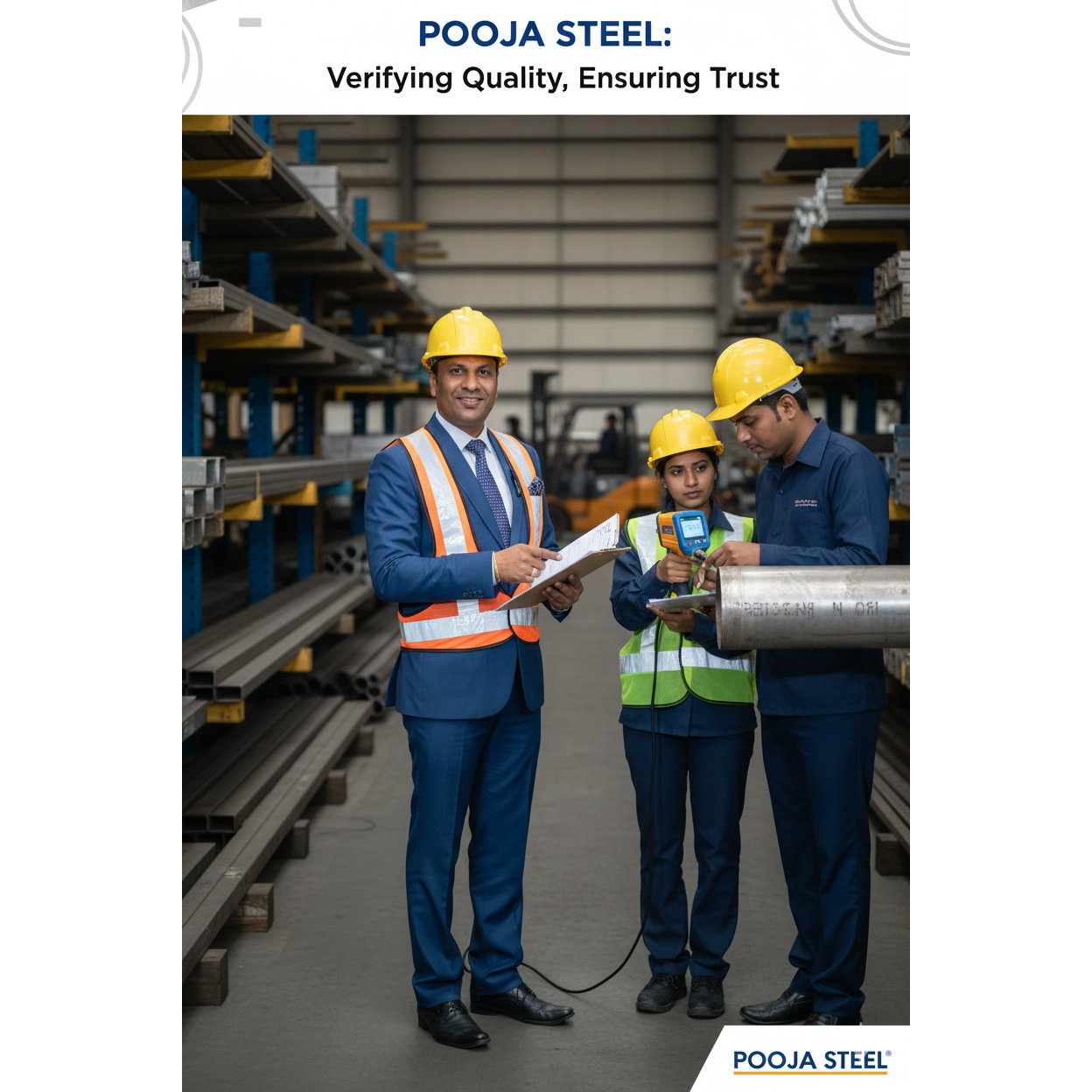
Beyond the MTC: How to Spot 'Fake' Steel in Your Supply Chain In the high-stakes world of industrial fabrication, oil & gas, pharma, and power generation, the integrity of your materials is non-negotiable. A compromised pipe, a faulty flange, or an incorrect alloy can lead to catastrophic failures, costly downtime, and even danger to human lives. You might assume that a Mill Test Certificate (MTC) is your golden ticket to authenticity. But what if that MTC is falsified, or the material itself has been swapped? Welcome to the hidden threat of 'fake' steel – substandard materials masquerading as quality alloys. At Pooja Steel, we don't just supply metals; we empower our clients with the knowledge to ensure absolute material verification. The Rise of the Impostors: Why 'Fake' Steel is a Real Threat The global supply chain, while efficient, has also become a breeding ground for unethical practices. From mislabeled grades to outright counterfeit documentation, 'fake' steel is a growing concern. The motivation is simple: cut costs, boost profits. The consequences for your project, however, can be devastating: • Premature Failure: A pipe rated for high pressure might burst due to incorrect alloy composition. • Corrosion Catastrophes: Using SS304 where SS316L was required can lead to rapid degradation in corrosive environments. • Regulatory Non-Compliance: Falling short of material specifications can result in failed inspections and legal liabilities. • Reputational Damage: Your company's credibility is on the line when project integrity is compromised. Relying solely on paper can be a costly mistake. It's time to equip your procurement and QA teams with practical verification methods. Your 3-Step Verification Process: Beyond the Paperwork Even with an MTC in hand, a multi-layered approach to material verification is crucial. Here’s a robust 3-step process to safeguard your supply chain: Step 1: Physical Markings – The First Line of Defense Before any sophisticated testing, conduct a thorough visual inspection. Legitimate materials, especially pipes, plates, and large components, should have clear, permanent markings. • Heat Number/Lot Number: This is critical. Every piece of metal from a specific pour (heat) will have a unique number. It's the primary link to its MTC. If missing or inconsistent, raise a red flag. • Grade Designation: Is the material clearly marked 'SS 316L, ' 'API 5L, ' or 'ASTM A106 Gr. B'? Check for proper stenciling, stamps, or tags. • Manufacturer's Logo/Name: Reputable mills brand their products. • Dimensional Accuracy: While not a material authenticity check, verify dimensions. Gross discrepancies can indicate a non-standard or fraudulent product. Red Flag Scenario: You receive a shipment of pipes, and the stenciled heat numbers are inconsistent, or easily rub off. This immediately warrants further investigation. Step 2: Chemical Testing (PMI) – Proving the Composition This is where metallurgy meets practicality. Positive Material Identification (PMI) testing is a non-destructive analytical method used to identify the elemental composition of materials. It's your most powerful tool against material mix-ups. • How it Works: A handheld PMI analyzer uses X-ray fluorescence (XRF) or Optical Emission Spectrometry (OES) to zap the material and identify its constituent elements (e.g., Chromium, Nickel, Molybdenum in stainless steel). It then displays the percentages, allowing you to confirm the alloy grade instantly. • Why it's Essential: An MTC might claim a pipe is SS316L (containing Molybdenum), but a quick PMI test will confirm if that critical element is actually present – and in the correct percentage. Without Molybdenum, your '316L' is essentially 304, severely compromising its corrosion resistance. • When to Use It: o Incoming Inspection: Randomly test a percentage of incoming materials. o Before Fabrication: Confirm materials before welding or costly processing. o Critical Components: Test 100% of high-pressure or high-corrosion materials. At Pooja Steel, we encourage and often provide PMI reports. We even offer to conduct PMI testing in front of our clients for full transparency. Step 3: Paperwork Audit – Scrutinizing the MTC While not foolproof, a diligent audit of the MTC itself can uncover anomalies. • Review against Standards: Does the MTC clearly state compliance with relevant ASTM, ASME, EN, or API standards? • Check Mill Details: Is the mill name legitimate? Does the MTC format match what you’d expect from that specific mill? Be wary of generic MTCs. • Compare Heat Numbers: Cross-reference the heat number on the MTC with the physical marking on the material (Step 1). They must match. • Chemical vs. Mechanical: Does the MTC include both chemical analysis and mechanical properties (tensile strength, yield strength)? A complete MTC provides a full material fingerprint. • Third-Party Inspection: For critical orders, request an independent third-party inspection report from a reputable agency. Red Flag Scenario: The MTC looks like a poorly scanned document, has grammatical errors, or lists generic contact information rather than a specific mill’s details. Why a 'Cheap' Price Today Leads to Catastrophe Tomorrow The allure of a lower price point for industrial materials can be powerful. However, when it comes to metals that are foundational to your operations, cutting corners on quality is a false economy. A few percentage points saved on procurement can lead to millions in repair costs, lost production, environmental damage, and even legal battles down the line. Your partners in material supply should be transparent, reliable, and knowledgeable. Partner with Pooja Steel: Your Certified Partner in Quality At Pooja Steel & Engineering Company, we pride ourselves on delivering not just materials, but certified assurance. Every pipe, fitting, flange, and bar we supply comes with guaranteed traceability and genuine Mill Test Certificates. Our commitment to quality means: • Authentic Sourcing: We partner only with reputable global mills. • Rigorous QA: Our internal quality checks are stringent. • Transparency: We welcome third-party inspections and provide comprehensive documentation. • Expert Knowledge: Our team understands the nuances of different alloys and industry standards. Don't let 'fake' steel compromise your projects. Demand transparency, conduct thorough checks, and partner with a supplier who values your trust as much as you value your safety and success. Ready to secure your supply chain with genuinely certified materials? Contact Pooja Steel today for a quote or consultation.


This is your website preview.
Currently it only shows your basic business info. Start adding relevant business details such as description, images and products or services to gain your customers attention by using Boost 360 android app / iOS App / web portal.
Beyond the MTC: How to Spot "Fake" Steel in Your Supply Chain,
2026-01-06T04:36:43
Beyond the MTC: How to Spot 'Fake' Steel in Your Supply Chain In the high-stakes world of industrial fabrication, oil & gas, pharma, and power generation, the integrity of your materials is non-negotiable. A compromised pipe, a faulty flange, or an incorrect alloy can lead to catastrophic failures, costly downtime, and even danger to human lives. You might assume that a Mill Test Certificate (MTC) is your golden ticket to authenticity. But what if that MTC is falsified, or the material itself has been swapped? Welcome to the hidden threat of 'fake' steel – substandard materials masquerading as quality alloys. At Pooja Steel, we don't just supply metals; we empower our clients with the knowledge to ensure absolute material verification. The Rise of the Impostors: Why 'Fake' Steel is a Real Threat The global supply chain, while efficient, has also become a breeding ground for unethical practices. From mislabeled grades to outright counterfeit documentation, 'fake' steel is a growing concern. The motivation is simple: cut costs, boost profits. The consequences for your project, however, can be devastating: • Premature Failure: A pipe rated for high pressure might burst due to incorrect alloy composition. • Corrosion Catastrophes: Using SS304 where SS316L was required can lead to rapid degradation in corrosive environments. • Regulatory Non-Compliance: Falling short of material specifications can result in failed inspections and legal liabilities. • Reputational Damage: Your company's credibility is on the line when project integrity is compromised. Relying solely on paper can be a costly mistake. It's time to equip your procurement and QA teams with practical verification methods. Your 3-Step Verification Process: Beyond the Paperwork Even with an MTC in hand, a multi-layered approach to material verification is crucial. Here’s a robust 3-step process to safeguard your supply chain: Step 1: Physical Markings – The First Line of Defense Before any sophisticated testing, conduct a thorough visual inspection. Legitimate materials, especially pipes, plates, and large components, should have clear, permanent markings. • Heat Number/Lot Number: This is critical. Every piece of metal from a specific pour (heat) will have a unique number. It's the primary link to its MTC. If missing or inconsistent, raise a red flag. • Grade Designation: Is the material clearly marked 'SS 316L, ' 'API 5L, ' or 'ASTM A106 Gr. B'? Check for proper stenciling, stamps, or tags. • Manufacturer's Logo/Name: Reputable mills brand their products. • Dimensional Accuracy: While not a material authenticity check, verify dimensions. Gross discrepancies can indicate a non-standard or fraudulent product. Red Flag Scenario: You receive a shipment of pipes, and the stenciled heat numbers are inconsistent, or easily rub off. This immediately warrants further investigation. Step 2: Chemical Testing (PMI) – Proving the Composition This is where metallurgy meets practicality. Positive Material Identification (PMI) testing is a non-destructive analytical method used to identify the elemental composition of materials. It's your most powerful tool against material mix-ups. • How it Works: A handheld PMI analyzer uses X-ray fluorescence (XRF) or Optical Emission Spectrometry (OES) to zap the material and identify its constituent elements (e.g., Chromium, Nickel, Molybdenum in stainless steel). It then displays the percentages, allowing you to confirm the alloy grade instantly. • Why it's Essential: An MTC might claim a pipe is SS316L (containing Molybdenum), but a quick PMI test will confirm if that critical element is actually present – and in the correct percentage. Without Molybdenum, your '316L' is essentially 304, severely compromising its corrosion resistance. • When to Use It: o Incoming Inspection: Randomly test a percentage of incoming materials. o Before Fabrication: Confirm materials before welding or costly processing. o Critical Components: Test 100% of high-pressure or high-corrosion materials. At Pooja Steel, we encourage and often provide PMI reports. We even offer to conduct PMI testing in front of our clients for full transparency. Step 3: Paperwork Audit – Scrutinizing the MTC While not foolproof, a diligent audit of the MTC itself can uncover anomalies. • Review against Standards: Does the MTC clearly state compliance with relevant ASTM, ASME, EN, or API standards? • Check Mill Details: Is the mill name legitimate? Does the MTC format match what you’d expect from that specific mill? Be wary of generic MTCs. • Compare Heat Numbers: Cross-reference the heat number on the MTC with the physical marking on the material (Step 1). They must match. • Chemical vs. Mechanical: Does the MTC include both chemical analysis and mechanical properties (tensile strength, yield strength)? A complete MTC provides a full material fingerprint. • Third-Party Inspection: For critical orders, request an independent third-party inspection report from a reputable agency. Red Flag Scenario: The MTC looks like a poorly scanned document, has grammatical errors, or lists generic contact information rather than a specific mill’s details. Why a 'Cheap' Price Today Leads to Catastrophe Tomorrow The allure of a lower price point for industrial materials can be powerful. However, when it comes to metals that are foundational to your operations, cutting corners on quality is a false economy. A few percentage points saved on procurement can lead to millions in repair costs, lost production, environmental damage, and even legal battles down the line. Your partners in material supply should be transparent, reliable, and knowledgeable. Partner with Pooja Steel: Your Certified Partner in Quality At Pooja Steel & Engineering Company, we pride ourselves on delivering not just materials, but certified assurance. Every pipe, fitting, flange, and bar we supply comes with guaranteed traceability and genuine Mill Test Certificates. Our commitment to quality means: • Authentic Sourcing: We partner only with reputable global mills. • Rigorous QA: Our internal quality checks are stringent. • Transparency: We welcome third-party inspections and provide comprehensive documentation. • Expert Knowledge: Our team understands the nuances of different alloys and industry standards. Don't let 'fake' steel compromise your projects. Demand transparency, conduct thorough checks, and partner with a supplier who values your trust as much as you value your safety and success. Ready to secure your supply chain with genuinely certified materials? Contact Pooja Steel today for a quote or consultation.
2026-01-06T04:36:43


Keywords
- Reputable global steel mills
- Pooja Steel supply chain safety
- Industry standards for steel verification
- Counterfeit steel detection methods
- Visual inspection of steel markings
- Steel chemical composition testing
- Authentic Mill Test Certificate validation
- Positive Material Identification testing
- How to spot fake steel
- Material verification in supply chain
Submit Your Enquiry