
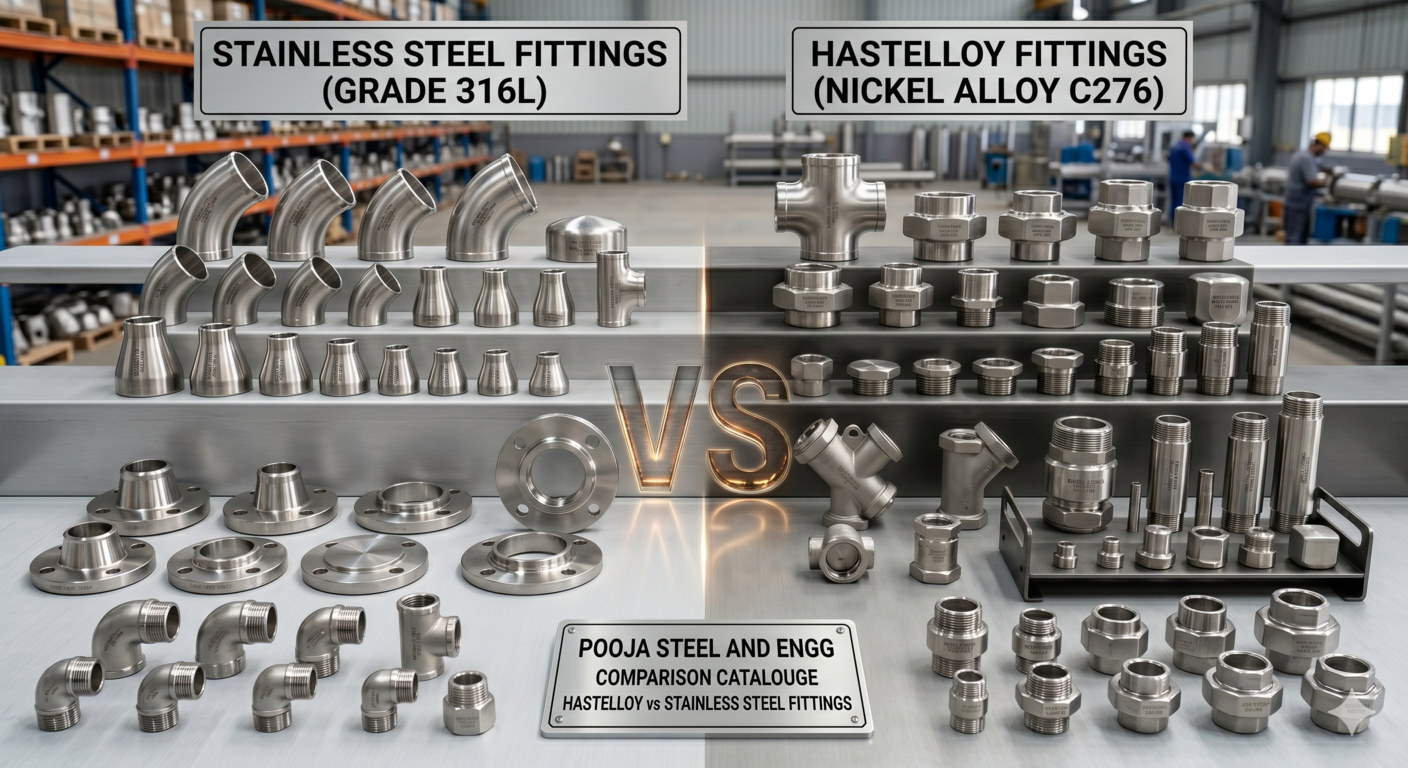
In the world of industrial piping, choosing the right material isn't just about the budget—it’s about the survival of your infrastructure. At Pooja Steel and Engg, we often get asked: 'Is it worth upgrading to Hastelloy, or will Stainless Steel get the job done?' The answer depends on your environment, temperature, and long-term ROI. In this comparison, we break down the key differences between these two industrial powerhouses to help you make an informed decision. 1. Chemical Composition: Iron vs. Nickel Base The fundamental difference lies in their 'DNA.' • Stainless Steel (e.g., 304, 316): An iron-based alloy. It relies on Chromium (usually 10.5% to 30%) to create a passive oxide layer that prevents rust. Grade 316 adds Molybdenum to help fight chlorides, but it remains primarily iron. • Hastelloy (e.g., C276, C22): A nickel-based superalloy. With nickel content often exceeding 50%, combined with high levels of Molybdenum and Chromium, it is engineered specifically for 'extreme' environments where iron-based metals would dissolve. 2. Corrosion Resistance: General vs. Aggressive Feature Stainless Steel (316L) Hastelloy (C276) Best For General rust, moisture, mild acids. Strong acids (Hydrochloric, Sulfuric). Pitting Resistance Moderate (vulnerable to high chlorides). Extreme (virtually immune in most media). Stress Cracking Can fail in high-stress, halide environments. Outstanding resistance to stress corrosion. Wet Chlorine Rapidly corrodes. One of the few alloys that survives it. The Pooja Steel Verdict: If you are handling salt water or mild chemicals, Stainless Steel is your cost-effective hero. But if your process involves aggressive reducing acids or wet chlorine gas, Hastelloy is a non-negotiable insurance policy. 3. Temperature Performance • Stainless Steel: Performs well up to approximately 800°C (1472°F). However, at very high temperatures, it can undergo oxidation and lose structural integrity. • Hastelloy: This is a 'superalloy' for a reason. It maintains its high tensile strength and resists oxidation even at temperatures exceeding 1000°C (1832°F), making it the gold standard for heat exchangers and nuclear reactors. 4. Cost and Long-Term Value There is no sugarcoating it: Hastelloy is significantly more expensive than Stainless Steel (often 5 to 10 times the price per kg). However, you must look at the Total Cost of Ownership (TCO): • Stainless Steel: Low initial cost, but high replacement frequency in harsh environments. • Hastelloy: High initial investment, but can last decades without maintenance or failure in the same harsh conditions. 5. Machinability and Fabrication • Stainless Steel: Relatively easy to weld, cut, and machine. It is the go-to for complex shapes and quick turnarounds. • Hastelloy: Much tougher to work with. It work-hardens quickly and requires specialized welding techniques to ensure the weld zone remains as corrosion-resistant as the rest of the fitting. _ Which Should You Choose? Choose Stainless Steel Fittings if: • You are in the food, beverage, or pharmaceutical industry with mild cleaning agents. • Your project is structural or decorative. • Budget is a primary constraint and the environment is not highly corrosive. Choose Hastelloy Fittings if: • You are operating a chemical processing or petrochemical plant. • You are dealing with sour gas or high-chloride marine environments. • The cost of a single leak or shutdown outweighs the cost of the material. Trust Pooja Steel and Engg for Both Whether you need the versatility of Stainless Steel or the indestructible nature of Hastelloy, Pooja Steel and Engg provides high-quality, certified fittings tailored to your specs. We supply both ASTM A182 (Stainless) and ASTM B366 (Hastelloy) components to ensure your plant runs safely and efficiently. Contact our technical team today for a comparison quote! Hastelloy vs Stainless Steel, Hastelloy C276 vs 316L, Pooja Steel and Engg, Corrosion Resistant Fittings, Industrial Pipe Fittings Comparison, Nickel Alloy vs Iron Alloy.


This is your website preview.
Currently it only shows your basic business info. Start adding relevant business details such as description, images and products or services to gain your customers attention by using Boost 360 android app / iOS App / web portal.
Hastelloy vs. Stainless Steel Fittings: Which One Does Your Project Truly Need?
2026-04-21T04:34:00
In the world of industrial piping, choosing the right material isn't just about the budget—it’s about the survival of your infrastructure. At Pooja Steel and Engg, we often get asked: 'Is it worth upgrading to Hastelloy, or will Stainless Steel get the job done?' The answer depends on your environment, temperature, and long-term ROI. In this comparison, we break down the key differences between these two industrial powerhouses to help you make an informed decision. 1. Chemical Composition: Iron vs. Nickel Base The fundamental difference lies in their 'DNA.' • Stainless Steel (e.g., 304, 316): An iron-based alloy. It relies on Chromium (usually 10.5% to 30%) to create a passive oxide layer that prevents rust. Grade 316 adds Molybdenum to help fight chlorides, but it remains primarily iron. • Hastelloy (e.g., C276, C22): A nickel-based superalloy. With nickel content often exceeding 50%, combined with high levels of Molybdenum and Chromium, it is engineered specifically for 'extreme' environments where iron-based metals would dissolve. 2. Corrosion Resistance: General vs. Aggressive Feature Stainless Steel (316L) Hastelloy (C276) Best For General rust, moisture, mild acids. Strong acids (Hydrochloric, Sulfuric). Pitting Resistance Moderate (vulnerable to high chlorides). Extreme (virtually immune in most media). Stress Cracking Can fail in high-stress, halide environments. Outstanding resistance to stress corrosion. Wet Chlorine Rapidly corrodes. One of the few alloys that survives it. The Pooja Steel Verdict: If you are handling salt water or mild chemicals, Stainless Steel is your cost-effective hero. But if your process involves aggressive reducing acids or wet chlorine gas, Hastelloy is a non-negotiable insurance policy. 3. Temperature Performance • Stainless Steel: Performs well up to approximately 800°C (1472°F). However, at very high temperatures, it can undergo oxidation and lose structural integrity. • Hastelloy: This is a 'superalloy' for a reason. It maintains its high tensile strength and resists oxidation even at temperatures exceeding 1000°C (1832°F), making it the gold standard for heat exchangers and nuclear reactors. 4. Cost and Long-Term Value There is no sugarcoating it: Hastelloy is significantly more expensive than Stainless Steel (often 5 to 10 times the price per kg). However, you must look at the Total Cost of Ownership (TCO): • Stainless Steel: Low initial cost, but high replacement frequency in harsh environments. • Hastelloy: High initial investment, but can last decades without maintenance or failure in the same harsh conditions. 5. Machinability and Fabrication • Stainless Steel: Relatively easy to weld, cut, and machine. It is the go-to for complex shapes and quick turnarounds. • Hastelloy: Much tougher to work with. It work-hardens quickly and requires specialized welding techniques to ensure the weld zone remains as corrosion-resistant as the rest of the fitting. _ Which Should You Choose? Choose Stainless Steel Fittings if: • You are in the food, beverage, or pharmaceutical industry with mild cleaning agents. • Your project is structural or decorative. • Budget is a primary constraint and the environment is not highly corrosive. Choose Hastelloy Fittings if: • You are operating a chemical processing or petrochemical plant. • You are dealing with sour gas or high-chloride marine environments. • The cost of a single leak or shutdown outweighs the cost of the material. Trust Pooja Steel and Engg for Both Whether you need the versatility of Stainless Steel or the indestructible nature of Hastelloy, Pooja Steel and Engg provides high-quality, certified fittings tailored to your specs. We supply both ASTM A182 (Stainless) and ASTM B366 (Hastelloy) components to ensure your plant runs safely and efficiently. Contact our technical team today for a comparison quote! Hastelloy vs Stainless Steel, Hastelloy C276 vs 316L, Pooja Steel and Engg, Corrosion Resistant Fittings, Industrial Pipe Fittings Comparison, Nickel Alloy vs Iron Alloy.
2026-04-21T04:34:00


Keywords
- Hastelloy C276 Seamless Pipe Fittings Supplier
- Industrial Grade Hastelloy Fittings Wholesale
- Hastelloy Pipe Fittings Exporters in India
- Pooja Steel and Engg Hastelloy Catalog
- Hastelloy Fittings Manufacturers near Vadodara
- Hastelloy X High Temperature Alloy Fittings
- Hastelloy C276 Concentric Reducer Dimensions
- High Pressure Hastelloy Forged Fittings Price
- Corrosion Resistant Hastelloy C276 Elbows
- ASME SB366 Hastelloy Butt Weld Fittings
- Hastelloy B2/B3 Reducing Acid Service Fittings
- Hastelloy C22 vs C276 for Chemical Plants
- UNS N10276 Hastelloy Fittings Supplier
- Nickel Alloy C276 Pipe Fittings Manufacturer
- ASTM B366 Hastelloy C276 Fittings
- Hastelloy C22 Flange Price List 2026
- Authorized Hastelloy Suppliers for Oil & Gas
- Hastelloy Alloy B3 Export Price
- Discounted Hastelloy C276 Sheet Prices
- Hastelloy Round Bar Manufacturers in Gujarat
- Request Quote for Hastelloy Fittings
- Hastelloy C276 Plate Stockist in India
- Hastelloy Alloy Suppliers in Mumbai
- Buy Hastelloy C22 Pipe Fittings Online
- Hastelloy C276 Price per kg in India
- Hastelloy vs Stainless Steel fittings comparison
- industrial pipe fittings Hastelloy 316L C276
- corrosion resistant fittings comparison
- Pooja Steel and Engg fittings
- Nickel alloy vs iron alloy corrosion resistance
Submit Your Enquiry