
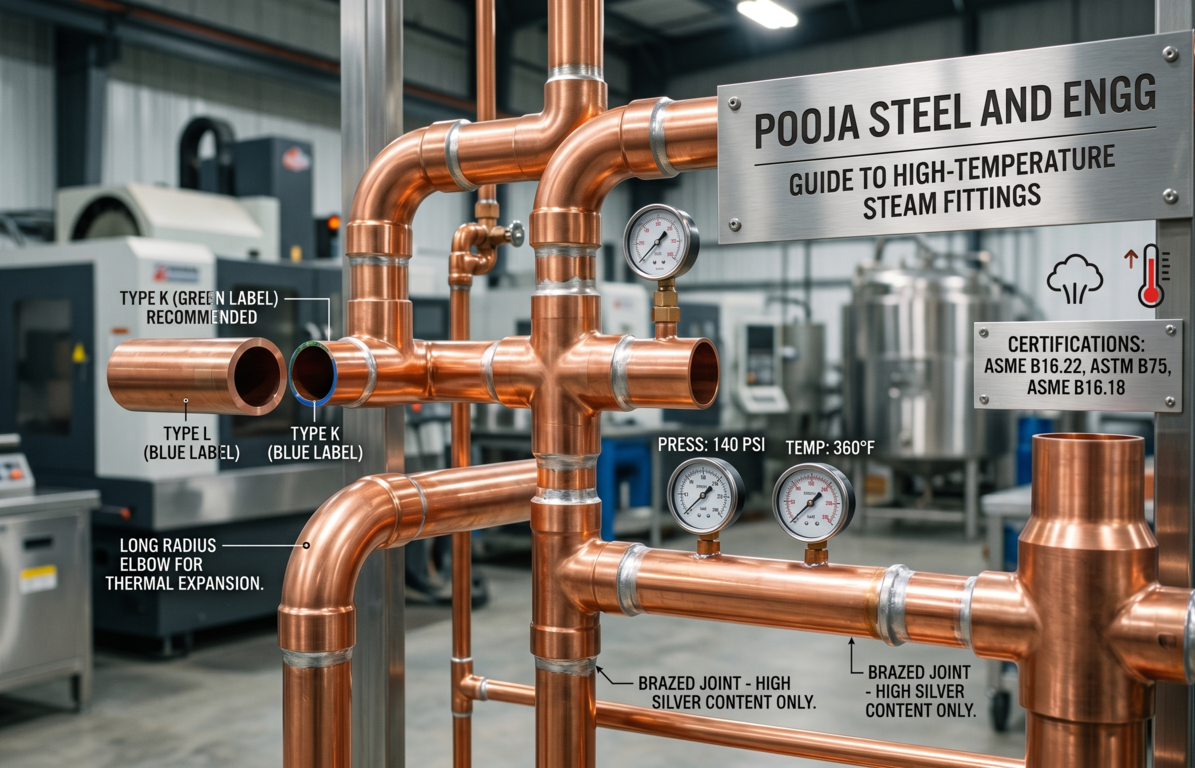
When it comes to steam systems, the margin for error is razor-thin. Choosing the wrong fitting doesn't just lead to a leak; it can lead to catastrophic system failure. At Pooja Steel and Engg, we understand that high-temperature steam requires a level of precision that goes beyond standard plumbing. In this guide, we’ll walk you through the critical factors for selecting copper fittings that can handle the heat, pressure, and intensity of industrial steam applications. 1. Understand the Steam Classification Before selecting a fitting, you must identify your system's 'operating temperature.' Steam behaves differently as it gets hotter: • Low-Pressure Steam: Generally below 15-25 psig. Standard copper can often handle this, but only with the right joining method. • Medium-Pressure Steam: Up to 125 psig. This requires thicker-walled tubing (Type K or L). • High-Temperature/High-Pressure Steam: Above 125 psig. At these levels, the structural integrity of the copper and the filler metal (solder/braze) becomes the primary concern. 2. Match the Copper Tube Type (K vs. L) Not all copper is created equal. For steam, wall thickness is your best friend. • Type K (Green Label): The thickest wall available. It is highly recommended for high-temperature steam and severe service conditions. • Type L (Blue Label): Standard thickness used for interior plumbing and heating. It is acceptable for lower-pressure steam but lacks the safety margin of Type K in heavy industrial environments. Pooja Steel Tip: Always avoid Type M (Red Label) for steam; its wall is too thin to safely manage the expansion and pressure of steam cycles. 3. The 'Weakest Link': Joining Methods In high-temperature systems, the fitting itself rarely fails—the joint does. • Soldering: Standard 50/50 or lead-free solder has a low melting point. It is unsuitable for high-temperature steam as the heat can soften the joint. • Brazing: This is the industry standard for steam. Brazing alloys (typically silver-based) melt at much higher temperatures (above 450°C or 842°F), ensuring the joint remains solid even when the steam is scalding. 4. Factor in Thermal Expansion Steam systems go from 'cold' to 'extremely hot' in minutes. Copper has a high coefficient of thermal expansion, meaning it will grow in length as it heats up. • The Choice: Use long-radius elbows instead of standard short-radius ones. These allow for more flexibility and reduce the stress on the fitting as the pipes expand and contract. • Expansion Loops: Ensure your layout includes expansion loops using copper tees and elbows to absorb movement without snapping a joint. 5. Verify Industry Standards (ASME & ASTM) To ensure safety at Pooja Steel and Engg, we recommend verifying that your fittings meet the following certifications: • ASME B16.22: For wrought copper and copper alloy solder-joint pressure fittings. • ASME B16.18: For cast copper alloy solder-joint pressure fittings. • ASTM B75/B88: Standards governing the seamless copper tube itself. Summary Selection Checklist Feature Steam System Requirement Copper Grade Minimum 99.9% Pure (C12200) Tube Type K (Preferred) or Type L Joining Method Brazing ONLY (High-silver content) Fitting Shape Long Radius (for expansion) Certification ASME B16.22 / ASTM B75 Why Source from Pooja Steel and Engg? High-temperature steam is a specialized field. At Pooja Steel and Engg, we don't just sell fittings; we provide the technical assurance that your components meet the highest industrial safety standards. Our copper fittings are designed to withstand the rigors of modern power plants, refineries, and industrial processing facilities. Need a technical consultation for your steam project? Contact our expert team at Pooja Steel and Engg today for high-quality, high-performance copper solutions. Copper Fittings for Steam, High-Temperature Copper Pipe Fittings, Pooja Steel and Engg, Type K vs Type L Copper, Brazing Copper Fittings, ASME B16.22 Standards, Industrial Steam Piping.


This is your website preview.
Currently it only shows your basic business info. Start adding relevant business details such as description, images and products or services to gain your customers attention by using Boost 360 android app / iOS App / web portal.
Mastering the Heat: How to Choose Copper Fittings for High-Temperature Steam
2026-04-22T04:57:43
When it comes to steam systems, the margin for error is razor-thin. Choosing the wrong fitting doesn't just lead to a leak; it can lead to catastrophic system failure. At Pooja Steel and Engg, we understand that high-temperature steam requires a level of precision that goes beyond standard plumbing. In this guide, we’ll walk you through the critical factors for selecting copper fittings that can handle the heat, pressure, and intensity of industrial steam applications. 1. Understand the Steam Classification Before selecting a fitting, you must identify your system's 'operating temperature.' Steam behaves differently as it gets hotter: • Low-Pressure Steam: Generally below 15-25 psig. Standard copper can often handle this, but only with the right joining method. • Medium-Pressure Steam: Up to 125 psig. This requires thicker-walled tubing (Type K or L). • High-Temperature/High-Pressure Steam: Above 125 psig. At these levels, the structural integrity of the copper and the filler metal (solder/braze) becomes the primary concern. 2. Match the Copper Tube Type (K vs. L) Not all copper is created equal. For steam, wall thickness is your best friend. • Type K (Green Label): The thickest wall available. It is highly recommended for high-temperature steam and severe service conditions. • Type L (Blue Label): Standard thickness used for interior plumbing and heating. It is acceptable for lower-pressure steam but lacks the safety margin of Type K in heavy industrial environments. Pooja Steel Tip: Always avoid Type M (Red Label) for steam; its wall is too thin to safely manage the expansion and pressure of steam cycles. 3. The 'Weakest Link': Joining Methods In high-temperature systems, the fitting itself rarely fails—the joint does. • Soldering: Standard 50/50 or lead-free solder has a low melting point. It is unsuitable for high-temperature steam as the heat can soften the joint. • Brazing: This is the industry standard for steam. Brazing alloys (typically silver-based) melt at much higher temperatures (above 450°C or 842°F), ensuring the joint remains solid even when the steam is scalding. 4. Factor in Thermal Expansion Steam systems go from 'cold' to 'extremely hot' in minutes. Copper has a high coefficient of thermal expansion, meaning it will grow in length as it heats up. • The Choice: Use long-radius elbows instead of standard short-radius ones. These allow for more flexibility and reduce the stress on the fitting as the pipes expand and contract. • Expansion Loops: Ensure your layout includes expansion loops using copper tees and elbows to absorb movement without snapping a joint. 5. Verify Industry Standards (ASME & ASTM) To ensure safety at Pooja Steel and Engg, we recommend verifying that your fittings meet the following certifications: • ASME B16.22: For wrought copper and copper alloy solder-joint pressure fittings. • ASME B16.18: For cast copper alloy solder-joint pressure fittings. • ASTM B75/B88: Standards governing the seamless copper tube itself. Summary Selection Checklist Feature Steam System Requirement Copper Grade Minimum 99.9% Pure (C12200) Tube Type K (Preferred) or Type L Joining Method Brazing ONLY (High-silver content) Fitting Shape Long Radius (for expansion) Certification ASME B16.22 / ASTM B75 Why Source from Pooja Steel and Engg? High-temperature steam is a specialized field. At Pooja Steel and Engg, we don't just sell fittings; we provide the technical assurance that your components meet the highest industrial safety standards. Our copper fittings are designed to withstand the rigors of modern power plants, refineries, and industrial processing facilities. Need a technical consultation for your steam project? Contact our expert team at Pooja Steel and Engg today for high-quality, high-performance copper solutions. Copper Fittings for Steam, High-Temperature Copper Pipe Fittings, Pooja Steel and Engg, Type K vs Type L Copper, Brazing Copper Fittings, ASME B16.22 Standards, Industrial Steam Piping.
2026-04-22T04:57:43


Keywords
- Solar Water Heater Copper Header Fittings
- Medical Oxygen Gas Pipeline Copper Fittings
- Refrigeration Grade Copper Elbows and Tees
- Marine Grade Corrosion Resistant Copper Fittings
- Copper Fittings for VRF Air Conditioning Systems
- Hard Drawn Copper Fittings for Industrial Use
- Copper End Feed Fittings Catalog
- Seamless Copper Pipe Fittings Specifications
- Lead-Free Copper Fittings for Potable Water
- High Pressure Copper Forged Fittings
- Copper Nickel 90/10 Pipe Fittings Manufacturer
- ASME B16.22 Copper Solder Joint Fittings
- Medical Grade Degreased Copper Fittings
- C12200 DHP Copper Fittings Price
- ASTM B75 Copper Fittings Supplier
- Custom Size Copper Fittings Manufacturer
- Copper Fittings Exporters in India
- Heavy Duty Copper Fittings for Sale
- Copper Plumbing Fittings Price List 2026
- Bulk Copper Fittings for HVAC Projects
- Copper Compression Fittings Supplier Gujarat
- Pooja Steel Copper Fittings Wholesale Price
- Copper Pipe Fittings Manufacturers in Mumbai
- Buy Industrial Copper Fittings Online
- Copper Fittings Price per kg in India
Submit Your Enquiry