
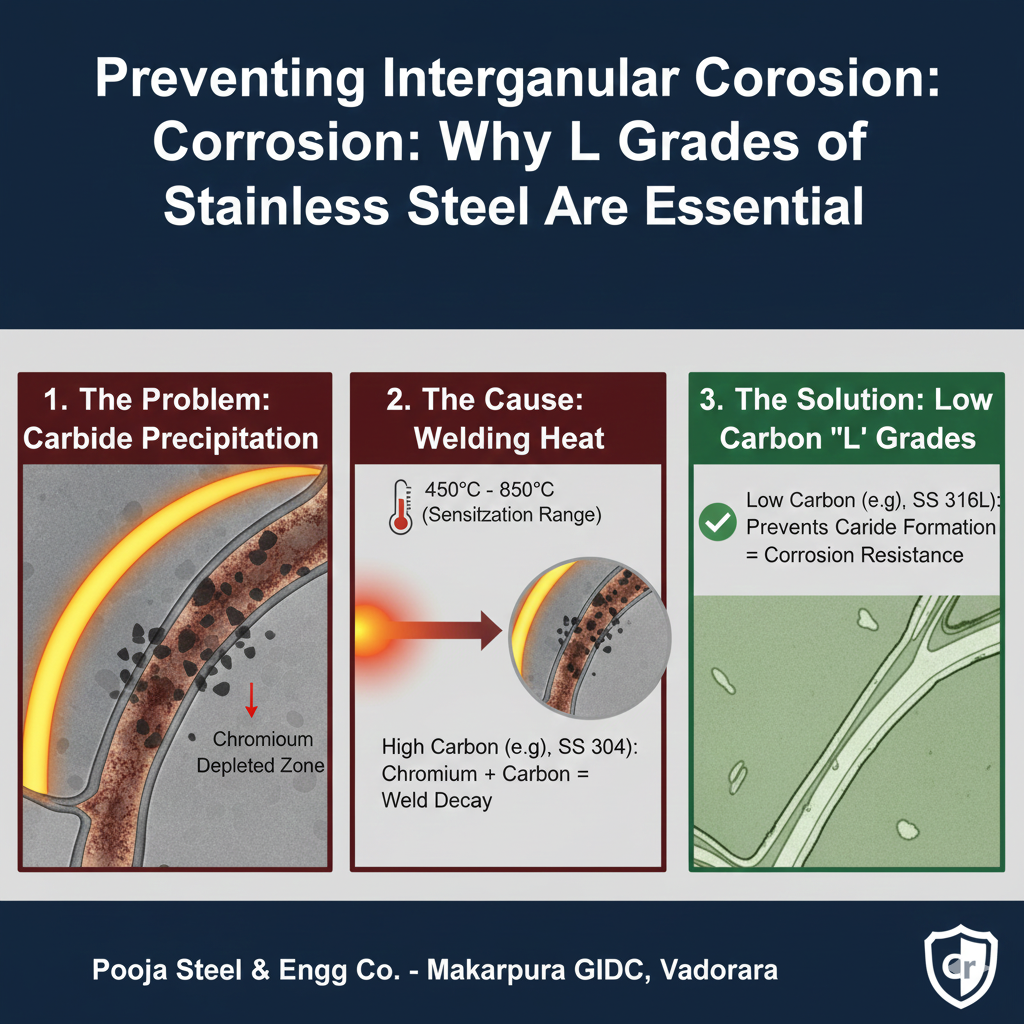
For industries in and around Vadodara that rely heavily on welding for fabrication, a hidden danger exists: intergranular corrosion (IGC). This phenomenon specifically attacks the grain boundaries of stainless steel, leading to premature failure even in otherwise sound structures. Understanding this is vital, which is why Pooja Steel & Engg Co. stocks and recommends L grades for critical welding applications. The Problem: Carbide Precipitation When standard austenitic stainless steel (like SS 304 or SS 316) is heated during welding, the carbon in the alloy combines with chromium. This occurs in the heat-affected zone (HAZ) in a temperature range of roughly $450°Cto 850°C, known as the sensitization range. This process is called carbide precipitation. As chromium is pulled out of the surrounding metal matrix to form these chromium carbides, the metal near the grain boundaries loses its minimum 10.5% chromium content. This makes these boundaries susceptible to attack by corrosive media, causing the material to 'sugar' or disintegrate along the grain lines—a form of IGC often called weld decay. The Solution: Using L Grades The solution is simple: minimize the carbon. The 'L' designation in stainless steel (e.g., SS 304L or SS 316L) stands for Low Carbon. SS 304 typically contains up to 0.08% Carbon. SS 304L contains a maximum of 0.03% Carbon. With such low carbon content, there are fewer atoms available to combine with chromium during welding, effectively preventing carbide precipitation and preserving the material’s corrosion resistance. Pooja Steel Advantage: Certified Low Carbon Supply As a responsible stockist in Makarpura GIDC, Pooja Steel & Engg Co. prioritizes the supply of certified 304L and 316L material for all process piping and pressure vessel applications where welding is involved. We ensure our materials meet the stringent carbon limits verified by their Mill Test Certificates (MTCs).


This is your website preview.
Currently it only shows your basic business info. Start adding relevant business details such as description, images and products or services to gain your customers attention by using Boost 360 android app / iOS App / web portal.
Preventing Intergranular Corrosion: Why "L" Grades of Stainless Steel Are Essential
2025-12-26T06:30:02
For industries in and around Vadodara that rely heavily on welding for fabrication, a hidden danger exists: intergranular corrosion (IGC). This phenomenon specifically attacks the grain boundaries of stainless steel, leading to premature failure even in otherwise sound structures. Understanding this is vital, which is why Pooja Steel & Engg Co. stocks and recommends L grades for critical welding applications. The Problem: Carbide Precipitation When standard austenitic stainless steel (like SS 304 or SS 316) is heated during welding, the carbon in the alloy combines with chromium. This occurs in the heat-affected zone (HAZ) in a temperature range of roughly $450°Cto 850°C, known as the sensitization range. This process is called carbide precipitation. As chromium is pulled out of the surrounding metal matrix to form these chromium carbides, the metal near the grain boundaries loses its minimum 10.5% chromium content. This makes these boundaries susceptible to attack by corrosive media, causing the material to 'sugar' or disintegrate along the grain lines—a form of IGC often called weld decay. The Solution: Using L Grades The solution is simple: minimize the carbon. The 'L' designation in stainless steel (e.g., SS 304L or SS 316L) stands for Low Carbon. SS 304 typically contains up to 0.08% Carbon. SS 304L contains a maximum of 0.03% Carbon. With such low carbon content, there are fewer atoms available to combine with chromium during welding, effectively preventing carbide precipitation and preserving the material’s corrosion resistance. Pooja Steel Advantage: Certified Low Carbon Supply As a responsible stockist in Makarpura GIDC, Pooja Steel & Engg Co. prioritizes the supply of certified 304L and 316L material for all process piping and pressure vessel applications where welding is involved. We ensure our materials meet the stringent carbon limits verified by their Mill Test Certificates (MTCs).
2025-12-26T06:30:02


Submit Your Enquiry