
The Engineer’s Guide to High-Performance Piping: Navigating Vapi’s Industrial Demands In the complex manufacturing landscape of Vapi, Gujarat, a piping system is far more than a collection of metal tubes. It is the lifeblood of a facility, tasked with transporting volatile chemicals, high-pressure steam, and high-purity ingredients. In an environment where downtime costs are measured by the minute and safety is non-negotiable, the difference between 'standard' and 'superior' materials is the difference between profit and catastrophe. At Pooja Steel & Engineering Co., we specialize in providing the complete architecture of industrial reliance. From manufacturing high-grade pipes to supplying precision-engineered fittings, we ensure that the infrastructure of South Gujarat remains resilient. ________________________________________ 1. Choosing Your Alloy: The SS304 vs. SS316 Debate The first decision in any piping project is the metallurgy. While both grades are austenitic stainless steels, their performance in Vapi’s specific environment differs significantly: • Grade 304 (The Workhorse): Best for food processing, textiles, and general utility lines. It offers excellent durability and corrosion resistance for standard industrial environments. • Grade 316 (The Specialist): Mandatory for chemical synthesis, pharmaceutical APIs, and effluent treatment. The addition of Molybdenum provides the 'Marine Grade' resilience needed to fight chloride-induced pitting common in local process water. ________________________________________ 2. SMLS vs. ERW: Structural Integrity Under Pressure How a pipe is made determines its ultimate pressure ceiling. • Seamless (SMLS): With no longitudinal weld, SMLS pipes are the gold standard for high-pressure reactors and critical hazardous fluid transport. • Electric Resistance Welded (ERW): Produced from cold-rolled steel strips, ERW pipes offer exceptional dimensional accuracy and cost-efficiency for medium-pressure systems. ________________________________________ 3. The Power of Precision Fittings: Beyond the Pipe A pipeline is only as secure as its transitions. Integrating the right fittings is essential for hydraulic stability: • Elbows: Facilitate smooth directional changes. Long-radius versions are preferred in Vapi's pulp and paper mills to reduce friction and erosion. • Reducers: Manage flow transitions. Eccentric reducers are vital for horizontal pump suctions to prevent gas entrapment (cavitation), while Concentric reducers maintain vertical flow symmetry. • Flanges: The critical link for equipment connectivity. Whether it’s a Weld Neck for high-pressure safety or a Blind Flange for system isolation, the seal must be absolute. ________________________________________ 4. Quality Assurance: The Non-Negotiable Standard In the heart of Vapi GIDC, material failure is not an option. Every component supplied by Pooja Steel & Engineering Co. undergoes a rigorous verification process: 1. PMI Testing: Chemical analysis to guarantee exact alloy composition. 2. Hydrostatic Verification: Ensuring leak-proof performance under operational stress. 3. Dimensional Gauging: Confirming all threads and wall thicknesses meet ASME/ASTM standards. 4. Full Traceability: Every product is accompanied by a Material Test Certificate (MTC). Your Strategic Partner in South Gujarat Building a world-class industrial facility requires more than just a supplier; it requires a partner who understands the local environmental challenges of Vapi and Sarigam. At Pooja Steel & Engineering Co., we combine manufacturing precision with deep logistical expertise to keep your project on schedule and your facility in operation. Are you planning a facility upgrade or a new process loop? Contact us today for a technical consultation. Let’s build the future of Gujarat’s industry, one precision joint at a time. Industrial Piping Solutions Vapi, SS304 vs SS316, Seamless Pipe Manufacturers Gujarat, Industrial Pipe Fittings Supplier, Pooja Steel & Engineering Co.


This is your website preview.
Currently it only shows your basic business info. Start adding relevant business details such as description, images and products or services to gain your customers attention by using Boost 360 android app / iOS App / web portal.
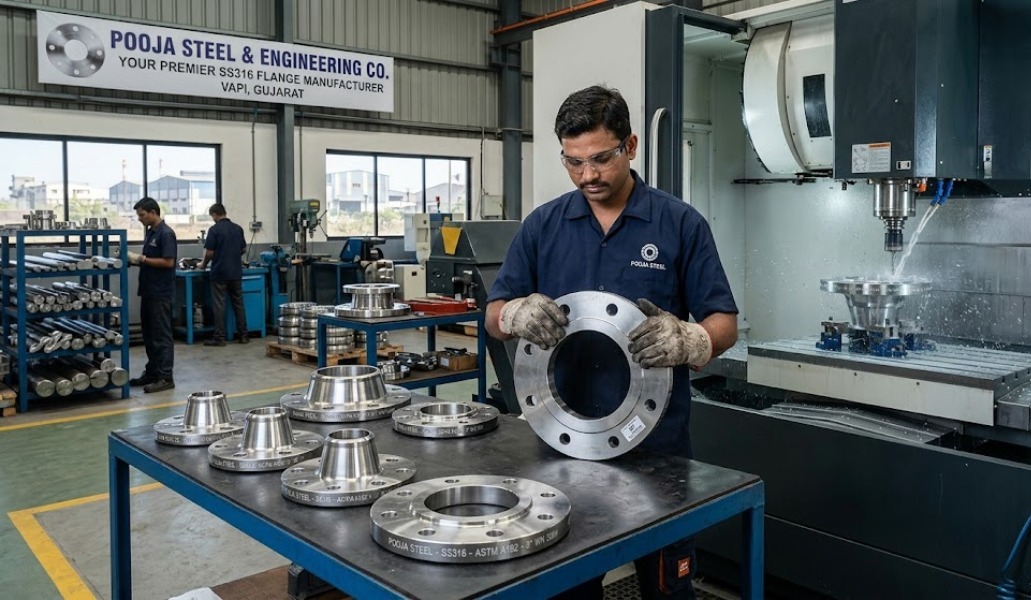
SS 316 flange manufacturer in Vapi Gujarat
2026-05-15T11:16:48
The Engineer’s Guide to High-Performance Piping: Navigating Vapi’s Industrial Demands In the complex manufacturing landscape of Vapi, Gujarat, a piping system is far more than a collection of metal tubes. It is the lifeblood of a facility, tasked with transporting volatile chemicals, high-pressure steam, and high-purity ingredients. In an environment where downtime costs are measured by the minute and safety is non-negotiable, the difference between 'standard' and 'superior' materials is the difference between profit and catastrophe. At Pooja Steel & Engineering Co., we specialize in providing the complete architecture of industrial reliance. From manufacturing high-grade pipes to supplying precision-engineered fittings, we ensure that the infrastructure of South Gujarat remains resilient. ________________________________________ 1. Choosing Your Alloy: The SS304 vs. SS316 Debate The first decision in any piping project is the metallurgy. While both grades are austenitic stainless steels, their performance in Vapi’s specific environment differs significantly: • Grade 304 (The Workhorse): Best for food processing, textiles, and general utility lines. It offers excellent durability and corrosion resistance for standard industrial environments. • Grade 316 (The Specialist): Mandatory for chemical synthesis, pharmaceutical APIs, and effluent treatment. The addition of Molybdenum provides the 'Marine Grade' resilience needed to fight chloride-induced pitting common in local process water. ________________________________________ 2. SMLS vs. ERW: Structural Integrity Under Pressure How a pipe is made determines its ultimate pressure ceiling. • Seamless (SMLS): With no longitudinal weld, SMLS pipes are the gold standard for high-pressure reactors and critical hazardous fluid transport. • Electric Resistance Welded (ERW): Produced from cold-rolled steel strips, ERW pipes offer exceptional dimensional accuracy and cost-efficiency for medium-pressure systems. ________________________________________ 3. The Power of Precision Fittings: Beyond the Pipe A pipeline is only as secure as its transitions. Integrating the right fittings is essential for hydraulic stability: • Elbows: Facilitate smooth directional changes. Long-radius versions are preferred in Vapi's pulp and paper mills to reduce friction and erosion. • Reducers: Manage flow transitions. Eccentric reducers are vital for horizontal pump suctions to prevent gas entrapment (cavitation), while Concentric reducers maintain vertical flow symmetry. • Flanges: The critical link for equipment connectivity. Whether it’s a Weld Neck for high-pressure safety or a Blind Flange for system isolation, the seal must be absolute. ________________________________________ 4. Quality Assurance: The Non-Negotiable Standard In the heart of Vapi GIDC, material failure is not an option. Every component supplied by Pooja Steel & Engineering Co. undergoes a rigorous verification process: 1. PMI Testing: Chemical analysis to guarantee exact alloy composition. 2. Hydrostatic Verification: Ensuring leak-proof performance under operational stress. 3. Dimensional Gauging: Confirming all threads and wall thicknesses meet ASME/ASTM standards. 4. Full Traceability: Every product is accompanied by a Material Test Certificate (MTC). Your Strategic Partner in South Gujarat Building a world-class industrial facility requires more than just a supplier; it requires a partner who understands the local environmental challenges of Vapi and Sarigam. At Pooja Steel & Engineering Co., we combine manufacturing precision with deep logistical expertise to keep your project on schedule and your facility in operation. Are you planning a facility upgrade or a new process loop? Contact us today for a technical consultation. Let’s build the future of Gujarat’s industry, one precision joint at a time. Industrial Piping Solutions Vapi, SS304 vs SS316, Seamless Pipe Manufacturers Gujarat, Industrial Pipe Fittings Supplier, Pooja Steel & Engineering Co.
2026-05-15T11:16:48


Keywords
- SS316 plate manufacturer in Vapi Gujarat
- SS304 plate supplier in Vapi Gujarat
- SS316 sheet manufacturer in Vapi Gujarat
- SS304 sheet supplier in Vapi Gujarat
- SS316 flange manufacturer in Vapi Gujarat
- SS304 flange supplier in Vapi Gujarat
- SS316 coupling manufacturer in Vapi Gujarat
- SS304 coupling supplier in Vapi Gujarat
- SS316 reducer manufacturer in Vapi Gujarat
- SS304 reducer supplier in Vapi Gujarat
- SS316 elbow manufacturer in Vapi Gujarat
- SS304 elbow supplier in Vapi Gujarat
- SS316 SMLS pipe manufacturer in Vapi Gujarat
- SS304 SMLS pipe supplier in Vapi Gujarat
- SS316 ERW pipe manufacturer in Vapi Gujarat
- SS304 ERW pipe supplier in Vapi Gujarat
- SS316 flange manufacturer Vapi
- Industrial piping solutions Vapi Gujarat
- Pooja Steel & Engineering Co
- Seamless pipe manufacturers Gujarat
- Industrial pipe fittings supplier Gujarat
Submit Your Enquiry