
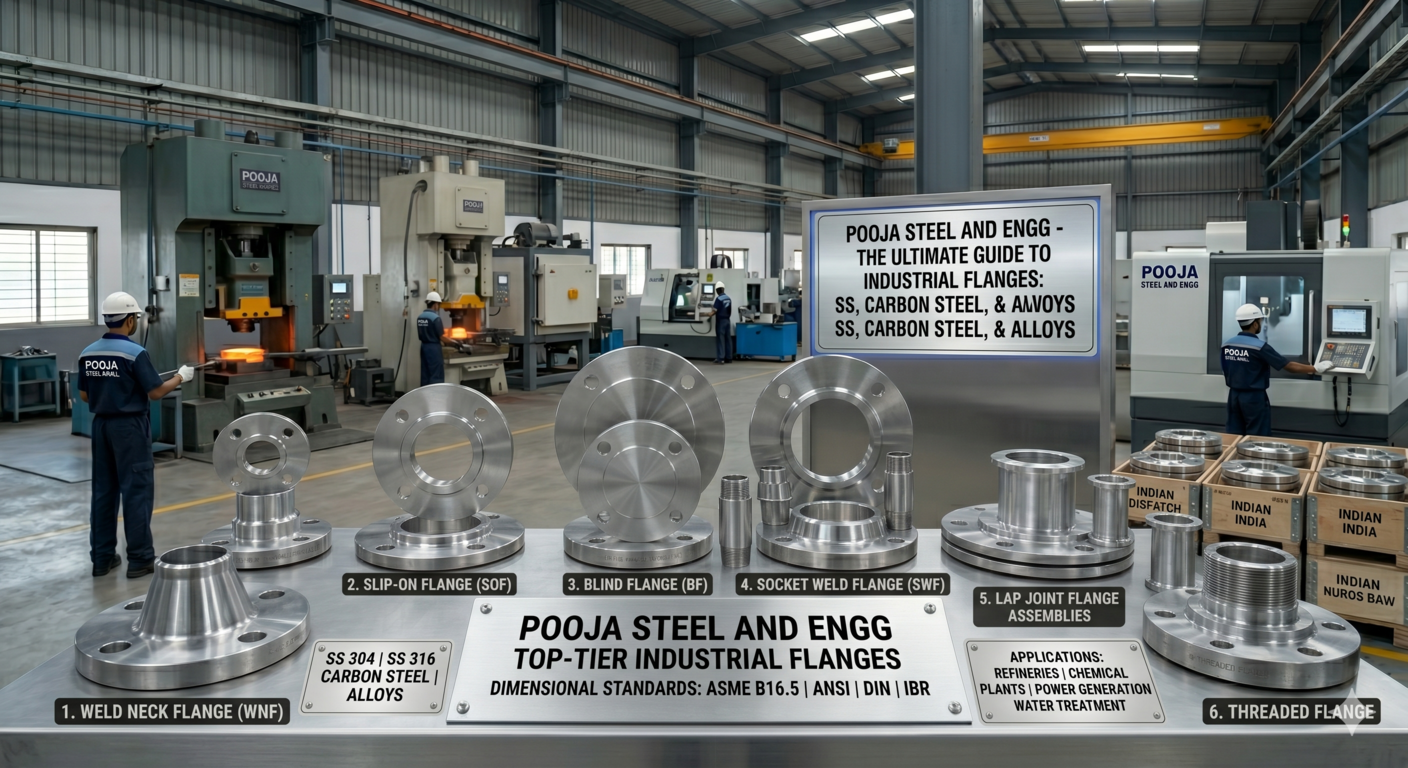
In the world of industrial piping, a flange is more than just a piece of hardware—it is the critical junction that ensures safety, facilitates maintenance, and maintains pressure integrity. At Pooja Steel and Engg, we understand that selecting the right flange can be the difference between a high-performing system and a costly maintenance nightmare. Whether you are working in a high-pressure refinery or a hygienic pharmaceutical plant, this guide breaks down the most common types of flanges and where they belong in your project. 1. Weld Neck Flanges (WNF) The 'Heavyweight Champion' of flanges. These are easily identified by their long, tapered hub that is butt-welded to the pipe. • Best For: High-pressure and high-temperature environments. • The Benefit: The tapered hub transfers stress from the flange to the pipe itself, providing structural reinforcement and reducing turbulence and erosion within the line. 2. Slip-On Flanges (SOF) As the name suggests, these flanges 'slip' over the pipe. They are slightly larger than the outer diameter of the pipe and are welded both inside and outside. • Best For: Low-pressure applications and where cost-efficiency is a priority. • The Benefit: They are easier to align than weld neck flanges and require less precision when cutting the pipe to length. 3. Blind Flanges (BF) Unlike other types, a blind flange has no center hole. It is used to seal the end of a piping system or a pressure vessel opening. • Best For: Terminating a line or providing a manhole for future inspection. • The Benefit: It allows for easy access to the interior of a line or vessel for cleaning or maintenance. 4. Socket Weld Flanges (SWF) These feature a 'socket' into which the pipe is inserted. A single fillet weld is then performed on the outside. • Best For: Small-diameter, high-pressure piping (typically 2 inches and below). • The Benefit: They provide a smooth bore and better flow characteristics than threaded flanges, though they are generally avoided in highly corrosive environments due to the 'gap' inside the socket. 5. Lap Joint Flanges (LJF) Used in conjunction with a 'Stub End, ' this flange slips over the pipe but is not welded to it. Instead, it backs up against the Stub End, which is welded to the pipe. • Best For: Systems that require frequent dismantling for cleaning or inspection. • The Benefit: Since the flange can rotate freely, it makes aligning bolt holes incredibly easy. It is also a cost-saver: you can use a high-grade stainless steel Stub End with a cheaper carbon steel Lap Joint flange. 6. Threaded Flanges These are similar to slip-on flanges but have internal threads. They are screwed onto pipes that have external threads. • Best For: Low-pressure systems where welding is not permitted or is hazardous (e.g., explosive environments). • The Benefit: No welding is required, making installation quick in specific specialized conditions. Key Selection Factors: At a Glance Flange Type Pressure Rating Welding Required? Primary Use Case Weld Neck High / Extreme Yes (Butt Weld) Refineries, Power Plants Slip-On Low / Moderate Yes (Fillet Weld) Water lines, Cooling loops Blind High No Sealing ends of pipes Socket Weld High (Small Bore) Yes (Fillet Weld) Chemical processing Lap Joint Low No (Welds to Stub) Systems needing cleaning Threaded Low No Explosive/Hazardous zones The Pooja Steel and Engg Quality Promise At Pooja Steel and Engg, we don't just supply flanges; we provide engineering confidence. All our flanges (SS 304, 316, Carbon Steel, and Alloys) are: • Precision Machined: Ensuring the 'Raised Face' or 'Flat Face' provides a perfect seal. • Certified: Every order comes with a Mill Test Certificate (MTC) for full material traceability. • Standard Compliant: Manufactured to ASME B16.5, ANSI, and DIN standards. Not sure which flange fits your pressure requirements? Our technical team in Vadodara is ready to help you navigate the complexities of flange selection to ensure your project is safe, compliant, and cost-effective. Contact Pooja Steel and Engg today for a custom quote and expert guidance on your industrial piping needs.


This is your website preview.
Currently it only shows your basic business info. Start adding relevant business details such as description, images and products or services to gain your customers attention by using Boost 360 android app / iOS App / web portal.
The Ultimate Guide to Industrial Flanges: Choosing the Right Connection for Your System
2026-04-25T04:43:54
In the world of industrial piping, a flange is more than just a piece of hardware—it is the critical junction that ensures safety, facilitates maintenance, and maintains pressure integrity. At Pooja Steel and Engg, we understand that selecting the right flange can be the difference between a high-performing system and a costly maintenance nightmare. Whether you are working in a high-pressure refinery or a hygienic pharmaceutical plant, this guide breaks down the most common types of flanges and where they belong in your project. 1. Weld Neck Flanges (WNF) The 'Heavyweight Champion' of flanges. These are easily identified by their long, tapered hub that is butt-welded to the pipe. • Best For: High-pressure and high-temperature environments. • The Benefit: The tapered hub transfers stress from the flange to the pipe itself, providing structural reinforcement and reducing turbulence and erosion within the line. 2. Slip-On Flanges (SOF) As the name suggests, these flanges 'slip' over the pipe. They are slightly larger than the outer diameter of the pipe and are welded both inside and outside. • Best For: Low-pressure applications and where cost-efficiency is a priority. • The Benefit: They are easier to align than weld neck flanges and require less precision when cutting the pipe to length. 3. Blind Flanges (BF) Unlike other types, a blind flange has no center hole. It is used to seal the end of a piping system or a pressure vessel opening. • Best For: Terminating a line or providing a manhole for future inspection. • The Benefit: It allows for easy access to the interior of a line or vessel for cleaning or maintenance. 4. Socket Weld Flanges (SWF) These feature a 'socket' into which the pipe is inserted. A single fillet weld is then performed on the outside. • Best For: Small-diameter, high-pressure piping (typically 2 inches and below). • The Benefit: They provide a smooth bore and better flow characteristics than threaded flanges, though they are generally avoided in highly corrosive environments due to the 'gap' inside the socket. 5. Lap Joint Flanges (LJF) Used in conjunction with a 'Stub End, ' this flange slips over the pipe but is not welded to it. Instead, it backs up against the Stub End, which is welded to the pipe. • Best For: Systems that require frequent dismantling for cleaning or inspection. • The Benefit: Since the flange can rotate freely, it makes aligning bolt holes incredibly easy. It is also a cost-saver: you can use a high-grade stainless steel Stub End with a cheaper carbon steel Lap Joint flange. 6. Threaded Flanges These are similar to slip-on flanges but have internal threads. They are screwed onto pipes that have external threads. • Best For: Low-pressure systems where welding is not permitted or is hazardous (e.g., explosive environments). • The Benefit: No welding is required, making installation quick in specific specialized conditions. Key Selection Factors: At a Glance Flange Type Pressure Rating Welding Required? Primary Use Case Weld Neck High / Extreme Yes (Butt Weld) Refineries, Power Plants Slip-On Low / Moderate Yes (Fillet Weld) Water lines, Cooling loops Blind High No Sealing ends of pipes Socket Weld High (Small Bore) Yes (Fillet Weld) Chemical processing Lap Joint Low No (Welds to Stub) Systems needing cleaning Threaded Low No Explosive/Hazardous zones The Pooja Steel and Engg Quality Promise At Pooja Steel and Engg, we don't just supply flanges; we provide engineering confidence. All our flanges (SS 304, 316, Carbon Steel, and Alloys) are: • Precision Machined: Ensuring the 'Raised Face' or 'Flat Face' provides a perfect seal. • Certified: Every order comes with a Mill Test Certificate (MTC) for full material traceability. • Standard Compliant: Manufactured to ASME B16.5, ANSI, and DIN standards. Not sure which flange fits your pressure requirements? Our technical team in Vadodara is ready to help you navigate the complexities of flange selection to ensure your project is safe, compliant, and cost-effective. Contact Pooja Steel and Engg today for a custom quote and expert guidance on your industrial piping needs.
2026-04-25T04:43:54


Keywords
- SS 304L SORF Flanges Supplier in Jamshedpur
- Stainless Steel Flanges in Mangalore
- SS 304 SORF Flanges Manufacturers in Nagpur
- SS 304L SORF Flange Supplier in Tiruchirappalli
- Stainless Steel SORF Flanges in Surat, Gujarat
- SS 304 SORF Flanges Manufacturers in Indore, Madhya Pradesh
- SS 304L SORF Flanges for Pharma in Baddi, Himachal Pradesh
- Industrial SS 304 Flanges in Paradip, Odisha
- SS 304L SORF Flanges Stockist in Ernakulam/Kochi
- Stainless Steel Flange Manufacturers in Coimbatore
- SS 304 SORF Flanges Supplier in Ludhiana, Punjab
- SS 304L SORF Flanges Price in Noida/NCR
- Stainless Steel SORF Flanges Manufacturers in Visakhapatnam
- Forged SS 304L Flanges in Kolkata, West Bengal
- SS 304 SORF Flanges Supplier in Bengaluru, Karnataka
- SS 304L SORF Flange Manufacturers in Chennai, Tamil Nadu
- Stainless Steel 304 SORF Flanges Stockist in Hyderabad
- Industrial SS SORF Flanges in Jamnagar, Gujarat
- SS 304L Slip-On Flanges Supplier in Pune
- SS 304 SORF Flange Manufacturers in Mumbai, Maharashtra
- industrial flanges guide
- Pooja Steel and Engg flanges
- ASME B16.5 DIN standards
- Vadodara flange experts
- weld neck vs slip-on flanges
Submit Your Enquiry