
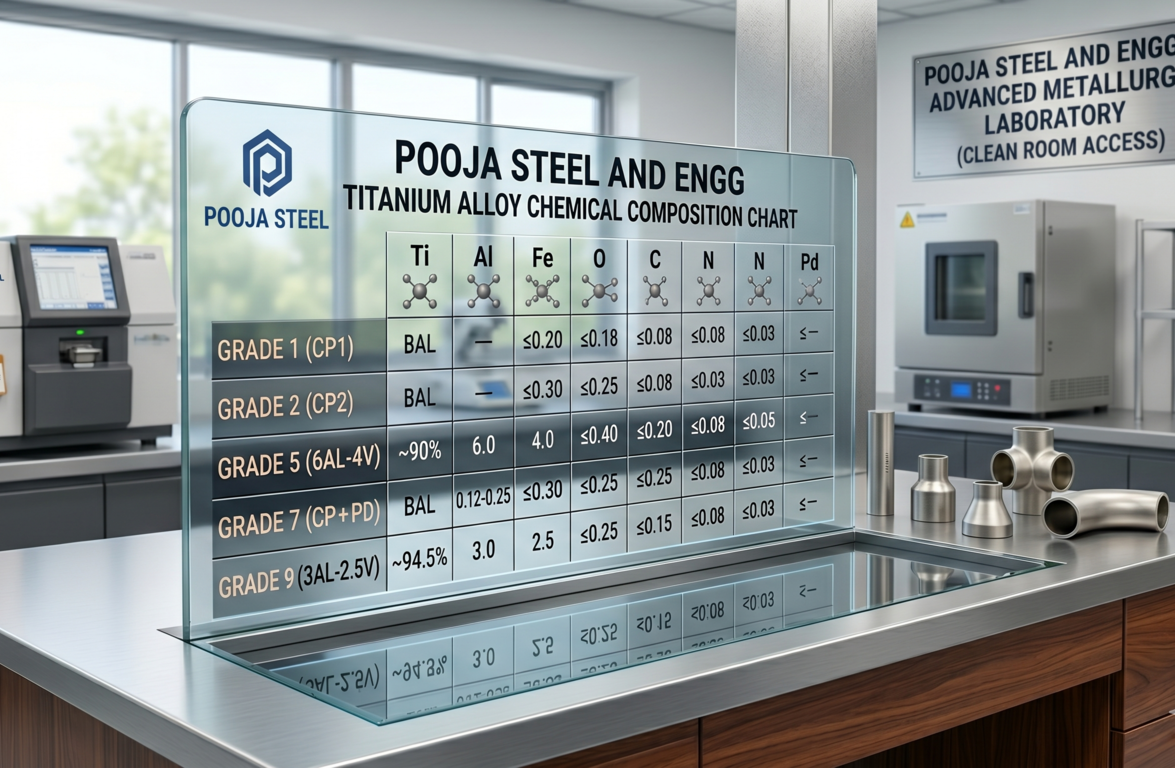
When selecting titanium alloys for critical industrial applications, there's no room for guesswork. The wrong composition can lead to premature failure in corrosive environments or insufficient strength under high pressure. At Pooja Steel and Engg, we are committed to transparency and technical accuracy. Understanding the atomic breakdown of these high-performance materials is the key to engineering success. This blog provides a definitive Pooja Steel Titanium Alloy Chemical Composition Chart and analyzes how specific elements dictate the performance of our leading titanium grades. The Pooja Steel Titanium Alloy Chemical Composition Chart This chart displays the typical ranges (by weight percent) for the primary elements within the standard titanium grades supplied and manufactured by Pooja Steel and Engg, compliant with ASTM specifications (e.g., ASTM B363, B381, B265). Decoding the Elements: How Composition Affects Performance The precise addition and control of specific elements define the distinct properties of each titanium grade. 1. Titanium (Ti) - The Resilient Base Titanium itself provides the foundational corrosion resistance through the formation of a stable, self-healing oxide layer. Grade 1 (CP1) is the purest form, offering the highest ductility but lower strength. 2. Aluminum (Al) - The Alpha Stabilizer (Strength) Aluminum increases the stable alpha phase in titanium, significantly boosting tensile strength and creep resistance, especially at elevated temperatures. Grade 5 contains 6% Al for this exact reason. 3. Vanadium (V) - The Beta Stabilizer (High-Strength Alloy) Vanadium stabilizes the beta phase, allowing for heat treatment and further enhancing strength and fracture toughness. This element is critical in forming high-strength Grade 5 (Ti-6Al-4V) and the durable Grade 9 (3AL-2.5V). 4. Palladium (Pd) - The Corrosion Catalyst Even tiny additions of palladium—like the 0.15% found in Grade 7—dramatically improve corrosion resistance in reducing acid environments (e.g., Hydrochloric and Sulfuric Acid) where unalloyed Grade 2 might fail. It acts as a cathodic depolarizer. 5. Interstitial Elements (Fe, O, N, C) Controlled in very small amounts, these are interstitial elements that increase strength but can reduce ductility and fracture toughness if levels are too high. Oxygen (O) is a potent solid-solution strengthener; hence, Grade 2 (CP2) has slightly higher O content than Grade 1 (CP1). Why Composition Matters to You Understanding this chemical composition chart helps you optimize material selection at Pooja Steel and Engg: • Maximize Lifespan: Choose Grade 7 with palladium for extreme acid service. • Optimize Weight: Utilize Grade 5 (Ti-6Al-4V) to achieve high strength with minimal material weight. • Ensure Weldability: Unalloyed Grade 2 offers the best balance of corrosion resistance and ease of fabrication/welding. The Pooja Steel and Engg Commitment At Pooja Steel and Engg, we don't just supply metal; we supply peace of mind. Every Titanium fitting, flange, or component we manufacture and distribute is backed by complete Mill Test Certificates (MTC) confirming that its chemical composition matches the technical data in this chart. We use rigorous Positive Material Identification (PMI) testing on every order. Contact Pooja Steel and Engg today! Need guidance on selecting the correct titanium grade for your next high-pressure or corrosive application? Our technical team in Vadodara is ready to help you analyze your system requirements based on this composition data. SEO Keywords Included: Titanium Alloy Chemical Composition Chart, Pooja Steel and Engg, Titanium Grade 2 vs Grade 5, ASTM B363 Titanium, Industrial Titanium Supplier India, Corrosion Resistance Titanium, Ti-6Al-4V Composition.


This is your website preview.
Currently it only shows your basic business info. Start adding relevant business details such as description, images and products or services to gain your customers attention by using Boost 360 android app / iOS App / web portal.
Titanium Alloy Chemical Composition Chart: Your Guide to Performance Grades
2026-04-23T05:05:13
When selecting titanium alloys for critical industrial applications, there's no room for guesswork. The wrong composition can lead to premature failure in corrosive environments or insufficient strength under high pressure. At Pooja Steel and Engg, we are committed to transparency and technical accuracy. Understanding the atomic breakdown of these high-performance materials is the key to engineering success. This blog provides a definitive Pooja Steel Titanium Alloy Chemical Composition Chart and analyzes how specific elements dictate the performance of our leading titanium grades. The Pooja Steel Titanium Alloy Chemical Composition Chart This chart displays the typical ranges (by weight percent) for the primary elements within the standard titanium grades supplied and manufactured by Pooja Steel and Engg, compliant with ASTM specifications (e.g., ASTM B363, B381, B265). Decoding the Elements: How Composition Affects Performance The precise addition and control of specific elements define the distinct properties of each titanium grade. 1. Titanium (Ti) - The Resilient Base Titanium itself provides the foundational corrosion resistance through the formation of a stable, self-healing oxide layer. Grade 1 (CP1) is the purest form, offering the highest ductility but lower strength. 2. Aluminum (Al) - The Alpha Stabilizer (Strength) Aluminum increases the stable alpha phase in titanium, significantly boosting tensile strength and creep resistance, especially at elevated temperatures. Grade 5 contains 6% Al for this exact reason. 3. Vanadium (V) - The Beta Stabilizer (High-Strength Alloy) Vanadium stabilizes the beta phase, allowing for heat treatment and further enhancing strength and fracture toughness. This element is critical in forming high-strength Grade 5 (Ti-6Al-4V) and the durable Grade 9 (3AL-2.5V). 4. Palladium (Pd) - The Corrosion Catalyst Even tiny additions of palladium—like the 0.15% found in Grade 7—dramatically improve corrosion resistance in reducing acid environments (e.g., Hydrochloric and Sulfuric Acid) where unalloyed Grade 2 might fail. It acts as a cathodic depolarizer. 5. Interstitial Elements (Fe, O, N, C) Controlled in very small amounts, these are interstitial elements that increase strength but can reduce ductility and fracture toughness if levels are too high. Oxygen (O) is a potent solid-solution strengthener; hence, Grade 2 (CP2) has slightly higher O content than Grade 1 (CP1). Why Composition Matters to You Understanding this chemical composition chart helps you optimize material selection at Pooja Steel and Engg: • Maximize Lifespan: Choose Grade 7 with palladium for extreme acid service. • Optimize Weight: Utilize Grade 5 (Ti-6Al-4V) to achieve high strength with minimal material weight. • Ensure Weldability: Unalloyed Grade 2 offers the best balance of corrosion resistance and ease of fabrication/welding. The Pooja Steel and Engg Commitment At Pooja Steel and Engg, we don't just supply metal; we supply peace of mind. Every Titanium fitting, flange, or component we manufacture and distribute is backed by complete Mill Test Certificates (MTC) confirming that its chemical composition matches the technical data in this chart. We use rigorous Positive Material Identification (PMI) testing on every order. Contact Pooja Steel and Engg today! Need guidance on selecting the correct titanium grade for your next high-pressure or corrosive application? Our technical team in Vadodara is ready to help you analyze your system requirements based on this composition data. SEO Keywords Included: Titanium Alloy Chemical Composition Chart, Pooja Steel and Engg, Titanium Grade 2 vs Grade 5, ASTM B363 Titanium, Industrial Titanium Supplier India, Corrosion Resistance Titanium, Ti-6Al-4V Composition.
2026-04-23T05:05:13


Submit Your Enquiry