
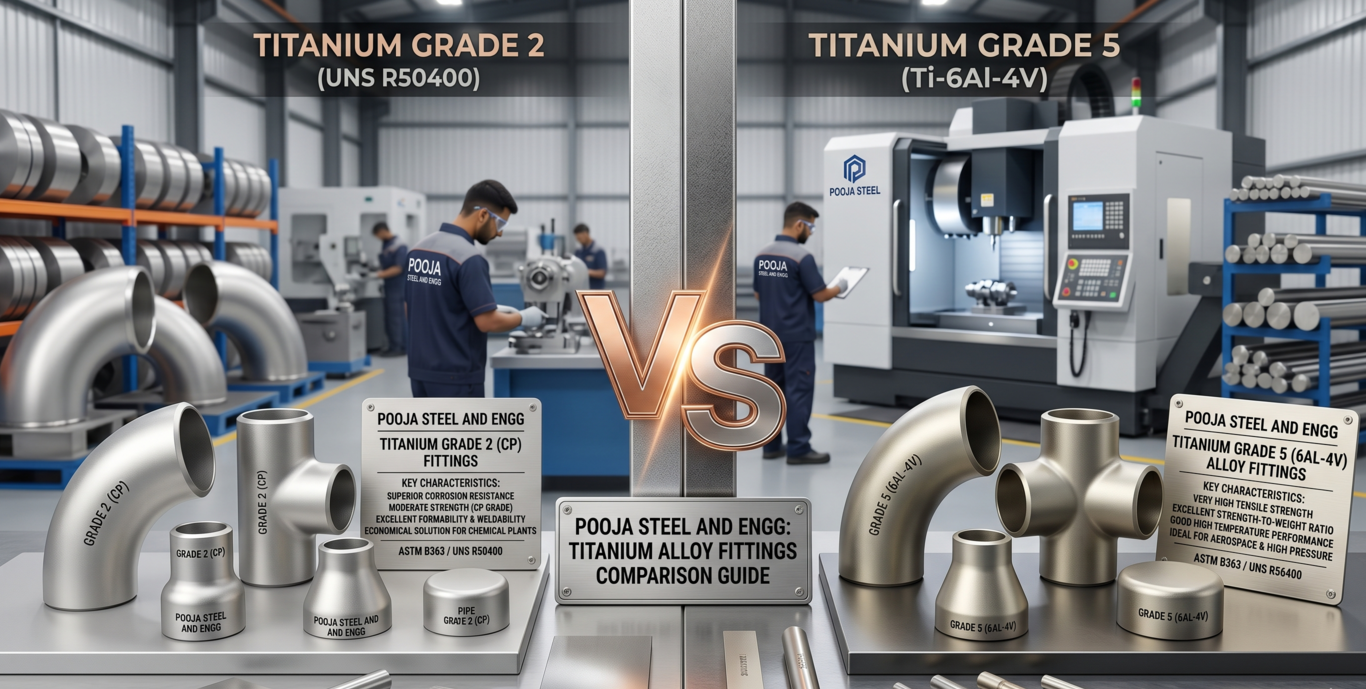
In the world of high-performance alloys, titanium is a heavyweight champion. However, not all titanium is created equal. At Pooja Steel and Engg, we frequently help clients navigate the choice between the two most popular industrial grades: Grade 2 and Grade 5. While both offer the legendary corrosion resistance titanium is known for, their mechanical capabilities are worlds apart. This guide breaks down the comparison to help you choose the right fitting for your specific industrial application. 1. The Fundamental Difference: Pure vs. Alloy • Titanium Grade 2 (Commercially Pure): This is the 'workhorse' of the industrial world. It is unalloyed, meaning it is nearly 99% pure titanium. It offers an incredible balance of moderate strength and excellent ductility. • Titanium Grade 5 (Ti-6Al-4V): This is an Alpha-Beta alloy. It contains 6% Aluminum and 4% Vanadium. Often called the 'aerospace grade, ' it is significantly stronger than Grade 2 but less 'stretchy' (ductile). 2. Performance Comparison Table Feature Grade 2 (UNS R50400) Grade 5 (UNS R56400) Composition Commercially Pure (CP) 6% Al, 4% V Tensile Strength Moderate (~345 MPa) Very High (~895 MPa) Corrosion Resistance Superior in most media Excellent (but slightly less than Gr 2) Formability/Ductility Excellent (Easy to cold-bend) Poor (Usually hot-formed) Weldability Exceptional Good (Requires specific expertise) Weight Very Light Very Light 3. Why Choose Grade 2 Fittings? For most chemical processing and marine environments, Grade 2 is the preferred choice at Pooja Steel and Engg. • Unrivaled Corrosion Resistance: Grade 2 performs exceptionally well in highly oxidizing environments, such as those involving wet chlorine or organic acids. • Ease of Fabrication: Because it is more ductile, Grade 2 fittings are easier to weld and form into complex piping layouts. • Cost-Effectiveness: Generally, Grade 2 is more affordable than the complex Grade 5 alloy, making it the standard for large-scale desalination and power plant projects. 4. Why Choose Grade 5 Fittings? When strength is your primary requirement, Grade 5 is the only answer. • High Pressure & Temperature: Grade 5 can withstand significantly higher internal pressures and maintains its strength better at temperatures up to 400°C (752°F). • Weight Critical Applications: Because it is so much stronger than Grade 2, you can often use thinner-walled Grade 5 fittings to achieve the same pressure rating, further reducing the overall weight of the system. • Aerospace & Military: Used where the 'strength-to-weight' ratio is the most critical design factor. 5. Which Grade Do You Need? At Pooja Steel and Engg, we use this simple rule of thumb: 1. Choose Grade 2 if your main concern is corrosion from seawater, acids, or chemicals in a standard industrial setting. It is the best choice for heat exchangers and chemical reactors. 2. Choose Grade 5 if your piping system operates under high pressure, extreme mechanical stress, or requires the highest possible strength-to-weight ratio. Quality Assurance at Pooja Steel and Engg Whether you require the corrosion-fighting power of Grade 2 or the extreme strength of Grade 5, every fitting we supply is: • ASTM B363 / B381 compliant. • Verified via PMI (Positive Material Identification). • Supplied with complete Mill Test Certificates (MTC). Contact Pooja Steel and Engg today! Our technical team in Vadodara is ready to help you analyze your system's pressure and chemistry to provide the perfect titanium solution. Titanium Grade 2 vs Grade 5, Ti-6Al-4V Fittings, Pooja Steel and Engg, Titanium Grade 2 Fittings Price, ASTM B363 Titanium, Industrial Titanium Supplier India, UNS R50400 vs UNS R56400.


This is your website preview.
Currently it only shows your basic business info. Start adding relevant business details such as description, images and products or services to gain your customers attention by using Boost 360 android app / iOS App / web portal.
Titanium Grade 2 vs. Grade 5 Fittings: Choosing the Right Strength for Your System
2026-04-23T04:56:50
In the world of high-performance alloys, titanium is a heavyweight champion. However, not all titanium is created equal. At Pooja Steel and Engg, we frequently help clients navigate the choice between the two most popular industrial grades: Grade 2 and Grade 5. While both offer the legendary corrosion resistance titanium is known for, their mechanical capabilities are worlds apart. This guide breaks down the comparison to help you choose the right fitting for your specific industrial application. 1. The Fundamental Difference: Pure vs. Alloy • Titanium Grade 2 (Commercially Pure): This is the 'workhorse' of the industrial world. It is unalloyed, meaning it is nearly 99% pure titanium. It offers an incredible balance of moderate strength and excellent ductility. • Titanium Grade 5 (Ti-6Al-4V): This is an Alpha-Beta alloy. It contains 6% Aluminum and 4% Vanadium. Often called the 'aerospace grade, ' it is significantly stronger than Grade 2 but less 'stretchy' (ductile). 2. Performance Comparison Table Feature Grade 2 (UNS R50400) Grade 5 (UNS R56400) Composition Commercially Pure (CP) 6% Al, 4% V Tensile Strength Moderate (~345 MPa) Very High (~895 MPa) Corrosion Resistance Superior in most media Excellent (but slightly less than Gr 2) Formability/Ductility Excellent (Easy to cold-bend) Poor (Usually hot-formed) Weldability Exceptional Good (Requires specific expertise) Weight Very Light Very Light 3. Why Choose Grade 2 Fittings? For most chemical processing and marine environments, Grade 2 is the preferred choice at Pooja Steel and Engg. • Unrivaled Corrosion Resistance: Grade 2 performs exceptionally well in highly oxidizing environments, such as those involving wet chlorine or organic acids. • Ease of Fabrication: Because it is more ductile, Grade 2 fittings are easier to weld and form into complex piping layouts. • Cost-Effectiveness: Generally, Grade 2 is more affordable than the complex Grade 5 alloy, making it the standard for large-scale desalination and power plant projects. 4. Why Choose Grade 5 Fittings? When strength is your primary requirement, Grade 5 is the only answer. • High Pressure & Temperature: Grade 5 can withstand significantly higher internal pressures and maintains its strength better at temperatures up to 400°C (752°F). • Weight Critical Applications: Because it is so much stronger than Grade 2, you can often use thinner-walled Grade 5 fittings to achieve the same pressure rating, further reducing the overall weight of the system. • Aerospace & Military: Used where the 'strength-to-weight' ratio is the most critical design factor. 5. Which Grade Do You Need? At Pooja Steel and Engg, we use this simple rule of thumb: 1. Choose Grade 2 if your main concern is corrosion from seawater, acids, or chemicals in a standard industrial setting. It is the best choice for heat exchangers and chemical reactors. 2. Choose Grade 5 if your piping system operates under high pressure, extreme mechanical stress, or requires the highest possible strength-to-weight ratio. Quality Assurance at Pooja Steel and Engg Whether you require the corrosion-fighting power of Grade 2 or the extreme strength of Grade 5, every fitting we supply is: • ASTM B363 / B381 compliant. • Verified via PMI (Positive Material Identification). • Supplied with complete Mill Test Certificates (MTC). Contact Pooja Steel and Engg today! Our technical team in Vadodara is ready to help you analyze your system's pressure and chemistry to provide the perfect titanium solution. Titanium Grade 2 vs Grade 5, Ti-6Al-4V Fittings, Pooja Steel and Engg, Titanium Grade 2 Fittings Price, ASTM B363 Titanium, Industrial Titanium Supplier India, UNS R50400 vs UNS R56400.
2026-04-23T04:56:50


Keywords
- IBR Approved Titanium Supplier
- ISO Certified Titanium Fittings
- UNS R50400 Titanium Grade 2 Fitting Manufacturer
- Titanium Buttweld Fittings ASTM B363 Standard
- Grade 5 Titanium Alloy (Ti-6Al-4V) Forged Fittings
- Titanium Schedule 40 vs Schedule 80 Dimensions
- ASTM B381 Titanium Forged Elbow and Tee
- Titanium Grade 7 Palladium-Stabilized Fittings
- Titanium Concentric Reducer ASME B16.9
- Titanium Pipe Fittings Price per kg 2026
- Industrial Titanium Fittings Exporters in India
- Titanium Grade 2 Seamless Fittings Stockist
- Titanium Pipe Fittings Wholesale Supplier Gujarat
- Buy Titanium UNS R56400 Elbows Online
- Custom Titanium Fabricated Fittings Vadodara
- Titanium Fittings for Chemical Fertilizer Plants
- Seawater Resistant Titanium Fittings for Desalination
- Medical Grade Titanium Tubing Connectors India
- Titanium Fittings for Offshore Oil & Gas Platforms
- Acid Resistant Titanium Grade 2 Pipe Caps
- Titanium Heat Exchanger Fittings Manufacturer
- Titanium Fittings for Wet Chlorine Service
- Titanium Grade 2 vs Grade 5 fittings
- Grade 2 vs Grade 5 Ti-6Al-4V comparison
- Pooja Steel and Engg titanium fittings
- UNS R50400 vs UNS R56400 titanium
- ASTM B363 titanium fittings India
Submit Your Enquiry