
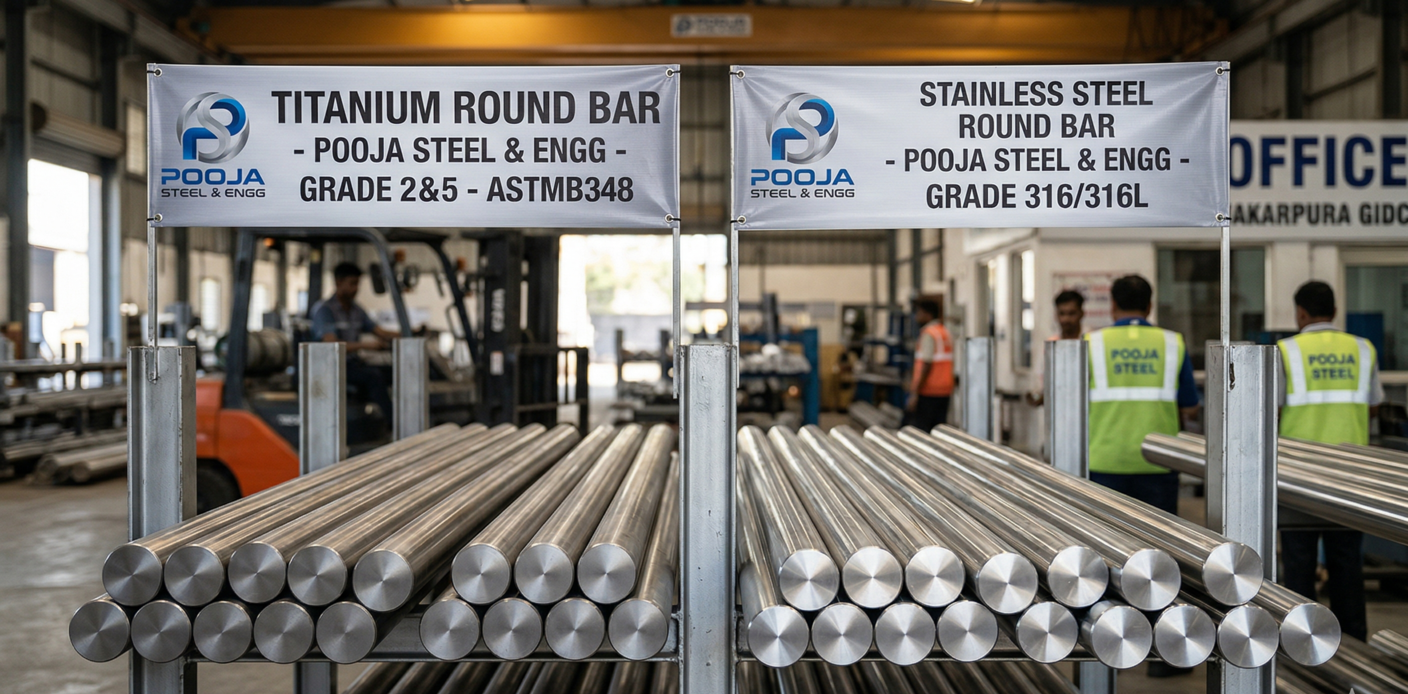
Choosing the right material for marine applications is one of the most critical decisions engineers and procurement officers face. The ocean is a relentless environment, where constant exposure to saltwater, salt spray, high humidity, and varied temperatures acts as a catalyst for destructive corrosion. Two of the most popular contenders for heavy-duty marine hardware are Titanium Round Bars and Stainless Steel Round Bars. Both offer strength and specialized properties, but they perform very differently under the stress of saline conditions. At Pooja Steel and Engg, based in Vadodara, Gujarat, we supply both high-quality titanium and stainless steel products to a wide range of industries. To help you make an informed choice for your next maritime project, we have created this comprehensive comparison breakdown. The Ultimate Challenge: Marine Corrosion Before we dive into the materials, it is essential to understand why the ocean is so tough on metals. Seawater contains high concentrations of chloride ions. These ions are extremely aggressive and excel at penetrating the protective passive layers of most metals, leading to localized attacks. The primary types of corrosion encountered in marine settings are: Pitting Corrosion: Small, localized holes (pits) form on the surface, weakening the core of the component. Crevice Corrosion: Corrosion occurring in confined spaces where the water becomes stagnant, such as under gaskets, bolt heads, or lap joints. Stress Corrosion Cracking (SCC): The combined effect of tensile stress and a corrosive environment, leading to sudden failure of ductile materials. Stainless Steel Round Bars: The Traditional Choice Stainless steel is the ubiquitous choice for marine hardware due to its availability, ease of fabrication, and cost-effectiveness. However, not all stainless steels are created equal. For marine environments, two grades dominate: 1. Grade 316/316L (The Marine Grade) ASTM A276 Grade 316 is considered the standard 'marine grade' stainless steel. It contains 2-3% Molybdenum, which significantly enhances its resistance to pitting and crevice corrosion caused by chloride ions compared to Grade 304. Best For: Deck hardware, boat fittings, coastal railings, fasteners, and component parts submerged in cooler waters. 2. Duplex Stainless Steel (Grades 2205/2507) Duplex stainless steels have a microstructure consisting of both austenite and ferrite. They offer nearly double the strength of standard austenitic grades (like 316) and superior resistance to pitting, crevice corrosion, and Stress Corrosion Cracking. Best For: High-stress offshore applications, propeller shafts, rudders, and desalination plant components. Advantages of Stainless Steel: Cost-Effective: Significantly cheaper upfront than titanium. Workability: Easier to machine, weld, and fabricate using standard shop tools. Availability: Widely available in numerous grades, sizes, and finishes (bright bar, smooth turn, etc.). Disadvantages of Stainless Steel: Susceptible to Localized Attack: Even 316 can suffer from 'tea staining' (surface rust) or pitting if not maintained or if used in warm, stagnant seawater. Weight: It is a dense material, adding significant weight to vessels. Titanium Round Bars: The High-Performance Contender If stainless steel is the reliable workhorse, Titanium is the elite athlete. Engineers often refer to titanium as the 'ocean metal' because of its spectacular immunity to seawater corrosion. Like stainless steel, titanium depends on a passive oxide film (TiO₂) for protection, but this film is far more tenacious, stable, and self-healing. Key grades used in marine applications: 1. Titanium Grade 2 (Commercially Pure) Grade 2 is the most common pure titanium grade. It offers an excellent balance of moderate strength, high ductility, and outstanding corrosion resistance. It is virtually immune to corrosion in seawater at temperatures up to 260°C. Best For: Seawater-cooled heat exchangers, piping systems, desalination equipment, and marine ballast tanks. 2. Titanium Grade 5 (Ti-6Al-4V Alloy) Grade 5 is an alloyed titanium, offering significantly higher tensile strength than Grade 2 while maintaining good corrosion resistance. It has an excellent strength-to-weight ratio. Best For: High-strength fasteners, submarine hardware, propeller shafts for high-speed craft, and offshore drilling components. Advantages of Titanium: Immunity to Corrosion: Completely resistant to pitting, crevice corrosion, and SCC in natural seawater, even at elevated temperatures. It requires zero corrosion allowance in design. Lightweight: It is approximately 45% lighter than steel but offers comparable strength. This is vital for vessel speed and fuel efficiency. Erosion Resistance: Extremely resistant to high-velocity water flow and cavitation. Disadvantages of Titanium: High Cost: The initial material cost is four to six times higher than stainless steel. Fabrication Difficulty: Requires specialized welding techniques (inert gas shielding) and is more challenging to machine. Which is Better for Your Project? The definition of 'better' depends entirely on your project's constraints and performance requirements. Choose Stainless Steel Round Bars if: 1. Budget is the Primary Concern: The project cannot absorb the high initial cost of titanium. 2. Maintenance is Manageable: The components are easily accessible for regular cleaning and inspection to prevent tea staining. 3. Application is Moderate: The hardware is used in splash zones, coastal environments, or cool, flowing water (Grade 316). 4. Complex Fabrication is Needed: You need to perform extensive machining or standard welding on-site. Choose Titanium Round Bars if: 1. Failure is Not an Option: The component is critical, submerged deep, or inaccessible for maintenance (e.g., submarine hull penetrations or submarine valves). 2. Weight Savings are Crucial: You are designing high-speed vessels, racing yachts, or offshore platforms where reducing weight improves performance or payload. 3. High Temperatures are Involved: The material will encounter hot brine or seawater (e.g., heat exchangers or desalination plants). 4. Life-Cycle Cost Matters: You are looking at the total cost of ownership over 20+ years. Titanium’s minimal maintenance and lack of replacement needs often make it the cheaper option in the long run. Your Trusted Supplier in Vadodara: Pooja Steel and Engg Whether you need the reliable economy of Grade 316 Stainless Steel Round Bars or the unparalleled immunity of Grade 5 Titanium Round Bars, Pooja Steel and Engg is your trusted local partner in Vadodara. We stock and supply a comprehensive range of metal round bars, tailored to meet your exact industrial specifications. Our experts can help you analyze your application requirements to ensure you select the most efficient and durable material for your marine project. Contact us today for a quote, technical specifications, or material selection advice.


This is your website preview.
Currently it only shows your basic business info. Start adding relevant business details such as description, images and products or services to gain your customers attention by using Boost 360 android app / iOS App / web portal.
Titanium Round Bar vs. Stainless Steel: Which is better for Marine Environments?
2026-03-26T04:45:09
Choosing the right material for marine applications is one of the most critical decisions engineers and procurement officers face. The ocean is a relentless environment, where constant exposure to saltwater, salt spray, high humidity, and varied temperatures acts as a catalyst for destructive corrosion. Two of the most popular contenders for heavy-duty marine hardware are Titanium Round Bars and Stainless Steel Round Bars. Both offer strength and specialized properties, but they perform very differently under the stress of saline conditions. At Pooja Steel and Engg, based in Vadodara, Gujarat, we supply both high-quality titanium and stainless steel products to a wide range of industries. To help you make an informed choice for your next maritime project, we have created this comprehensive comparison breakdown. The Ultimate Challenge: Marine Corrosion Before we dive into the materials, it is essential to understand why the ocean is so tough on metals. Seawater contains high concentrations of chloride ions. These ions are extremely aggressive and excel at penetrating the protective passive layers of most metals, leading to localized attacks. The primary types of corrosion encountered in marine settings are: Pitting Corrosion: Small, localized holes (pits) form on the surface, weakening the core of the component. Crevice Corrosion: Corrosion occurring in confined spaces where the water becomes stagnant, such as under gaskets, bolt heads, or lap joints. Stress Corrosion Cracking (SCC): The combined effect of tensile stress and a corrosive environment, leading to sudden failure of ductile materials. Stainless Steel Round Bars: The Traditional Choice Stainless steel is the ubiquitous choice for marine hardware due to its availability, ease of fabrication, and cost-effectiveness. However, not all stainless steels are created equal. For marine environments, two grades dominate: 1. Grade 316/316L (The Marine Grade) ASTM A276 Grade 316 is considered the standard 'marine grade' stainless steel. It contains 2-3% Molybdenum, which significantly enhances its resistance to pitting and crevice corrosion caused by chloride ions compared to Grade 304. Best For: Deck hardware, boat fittings, coastal railings, fasteners, and component parts submerged in cooler waters. 2. Duplex Stainless Steel (Grades 2205/2507) Duplex stainless steels have a microstructure consisting of both austenite and ferrite. They offer nearly double the strength of standard austenitic grades (like 316) and superior resistance to pitting, crevice corrosion, and Stress Corrosion Cracking. Best For: High-stress offshore applications, propeller shafts, rudders, and desalination plant components. Advantages of Stainless Steel: Cost-Effective: Significantly cheaper upfront than titanium. Workability: Easier to machine, weld, and fabricate using standard shop tools. Availability: Widely available in numerous grades, sizes, and finishes (bright bar, smooth turn, etc.). Disadvantages of Stainless Steel: Susceptible to Localized Attack: Even 316 can suffer from 'tea staining' (surface rust) or pitting if not maintained or if used in warm, stagnant seawater. Weight: It is a dense material, adding significant weight to vessels. Titanium Round Bars: The High-Performance Contender If stainless steel is the reliable workhorse, Titanium is the elite athlete. Engineers often refer to titanium as the 'ocean metal' because of its spectacular immunity to seawater corrosion. Like stainless steel, titanium depends on a passive oxide film (TiO₂) for protection, but this film is far more tenacious, stable, and self-healing. Key grades used in marine applications: 1. Titanium Grade 2 (Commercially Pure) Grade 2 is the most common pure titanium grade. It offers an excellent balance of moderate strength, high ductility, and outstanding corrosion resistance. It is virtually immune to corrosion in seawater at temperatures up to 260°C. Best For: Seawater-cooled heat exchangers, piping systems, desalination equipment, and marine ballast tanks. 2. Titanium Grade 5 (Ti-6Al-4V Alloy) Grade 5 is an alloyed titanium, offering significantly higher tensile strength than Grade 2 while maintaining good corrosion resistance. It has an excellent strength-to-weight ratio. Best For: High-strength fasteners, submarine hardware, propeller shafts for high-speed craft, and offshore drilling components. Advantages of Titanium: Immunity to Corrosion: Completely resistant to pitting, crevice corrosion, and SCC in natural seawater, even at elevated temperatures. It requires zero corrosion allowance in design. Lightweight: It is approximately 45% lighter than steel but offers comparable strength. This is vital for vessel speed and fuel efficiency. Erosion Resistance: Extremely resistant to high-velocity water flow and cavitation. Disadvantages of Titanium: High Cost: The initial material cost is four to six times higher than stainless steel. Fabrication Difficulty: Requires specialized welding techniques (inert gas shielding) and is more challenging to machine. Which is Better for Your Project? The definition of 'better' depends entirely on your project's constraints and performance requirements. Choose Stainless Steel Round Bars if: 1. Budget is the Primary Concern: The project cannot absorb the high initial cost of titanium. 2. Maintenance is Manageable: The components are easily accessible for regular cleaning and inspection to prevent tea staining. 3. Application is Moderate: The hardware is used in splash zones, coastal environments, or cool, flowing water (Grade 316). 4. Complex Fabrication is Needed: You need to perform extensive machining or standard welding on-site. Choose Titanium Round Bars if: 1. Failure is Not an Option: The component is critical, submerged deep, or inaccessible for maintenance (e.g., submarine hull penetrations or submarine valves). 2. Weight Savings are Crucial: You are designing high-speed vessels, racing yachts, or offshore platforms where reducing weight improves performance or payload. 3. High Temperatures are Involved: The material will encounter hot brine or seawater (e.g., heat exchangers or desalination plants). 4. Life-Cycle Cost Matters: You are looking at the total cost of ownership over 20+ years. Titanium’s minimal maintenance and lack of replacement needs often make it the cheaper option in the long run. Your Trusted Supplier in Vadodara: Pooja Steel and Engg Whether you need the reliable economy of Grade 316 Stainless Steel Round Bars or the unparalleled immunity of Grade 5 Titanium Round Bars, Pooja Steel and Engg is your trusted local partner in Vadodara. We stock and supply a comprehensive range of metal round bars, tailored to meet your exact industrial specifications. Our experts can help you analyze your application requirements to ensure you select the most efficient and durable material for your marine project. Contact us today for a quote, technical specifications, or material selection advice.
2026-03-26T04:45:09


Keywords
- Titanium Round Bar vs. Stainless Steel
- Cold drawn titanium round bar vs. hot rolled
- Titanium round bar 10mm to 100mm stockist
- Titanium round bar weight per foot calculatorDifference between Grade 2 and Grade 5 titanium rods
- ASTM B348 Grade 5 titanium round bar specifications
- High-strength titanium rods for oil and gas
- Titanium bars for marine hardware
- Corrosion-resistant titanium bars for chemical plants
- Medical grade titanium rods for implants
- Aerospace grade titanium round bars
- Titanium material suppliers near me
- Best titanium bar dealer in Makarpura GIDC
- Titanium round bar price in Ahmedabad
- Titanium rod suppliers in India
- Titanium rod suppliers in Gujarat
- Titanium round bar manufacturers in Vadodara
- Titanium Bright Bar
- ASTM B348 Titanium Round Bar
- Titanium Grade 5 (Ti-6Al-4V) Round Bar
- Titanium Grade 2 Round Bar
- Titanium Alloy Bar
- Titanium Rods
- Titanium Round Bar
- marine stainless steel round bars
- titanium round bars marine applications
- Grade 316 stainless steel marine
- Grade 5 titanium round bars
- Vadodara titanium stainless supplier
Submit Your Enquiry