
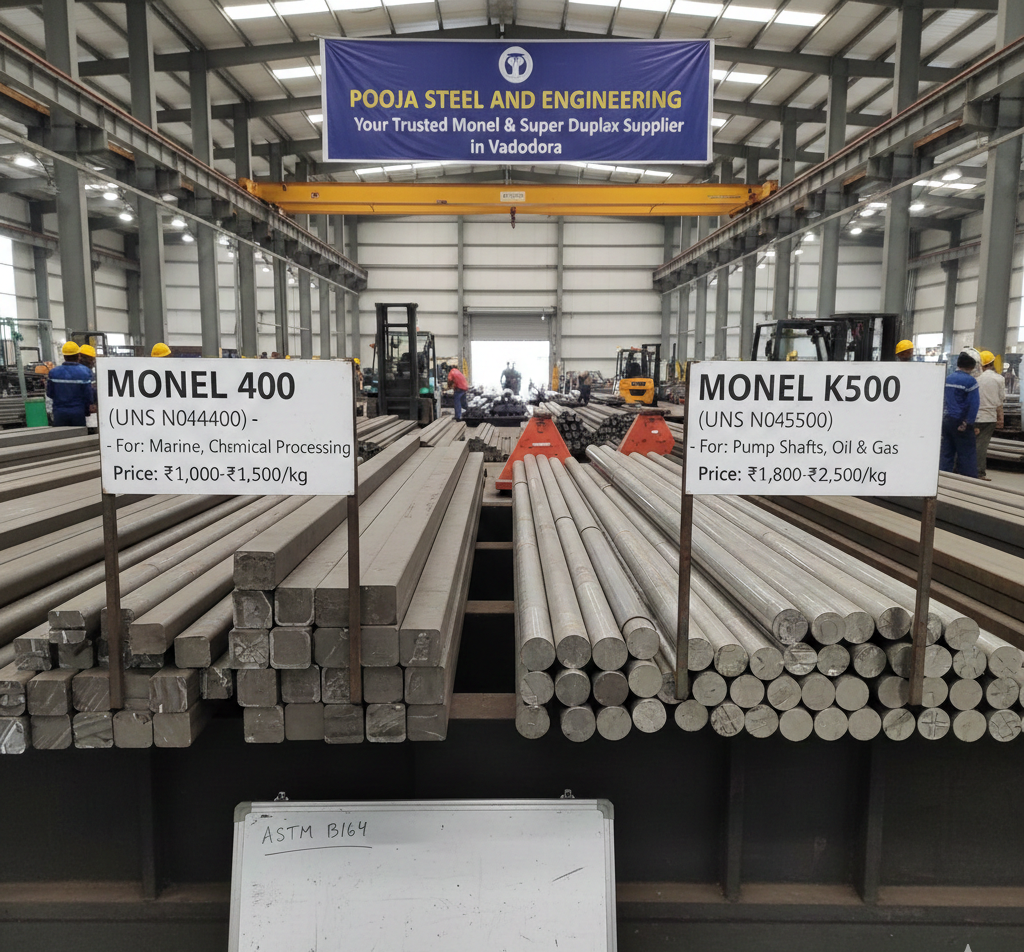
When it comes to high-performance nickel-copper alloys, Monel is a name that stands for unparalleled corrosion resistance. However, for engineers and procurement specialists at companies like Pooja Steel and Engineering, choosing between Monel 400 and Monel K500 round bars is a critical decision that impacts both project performance and budget. While they share a similar base of nickel and copper, their mechanical behaviours are worlds apart. In this guide, we break down the key differences to help you make the right choice for your industrial applications in Vadodara and beyond. 1. Chemical Composition: The 'Secret Ingredients' The fundamental difference lies in two small but powerful additions: Aluminum and Titanium. • Monel 400 (UNS N04400): A solid-solution alloy primarily composed of roughly 63% Nickel and 30% Copper. It relies on its basic chemistry for its properties. • Monel K500 (UNS N05500): Contains the same Nickel-Copper base but adds approximately 2.3% to 3.15% Aluminum and 0.35% to 0.85% Titanium. These elements allow the alloy to undergo 'age-hardening, ' which exponentially increases its strength. 2. Mechanical Strength: Performance Under Pressure If your application involves high stress or heavy loads, the choice becomes clear very quickly. • Yield Strength: Monel K500 is significantly stronger. In its age-hardened state, K500 has 3 times the yield strength and double the tensile strength of Monel 400. • Hardness: Monel 400 is relatively 'soft' and ductile, making it easier to form. Monel K500, however, is much harder and more resistant to wear and fatigue, which is why it is preferred for rotating parts like pump shafts. Property Monel 400 (Typical) Monel K500 (Aged) Tensile Strength ~550 MPa ~1100 MPa Yield Strength ~240 MPa ~790 MPa Hardness (Brinell) ~150 HB ~300+ HB 3. Corrosion Resistance: Shared Excellence Both grades offer 'legendary' resistance to seawater, hydrofluoric acid, sulfuric acid, and alkalis. However, there are subtle nuances: • Monel 400 is the gold standard for marine engineering and chemical heat exchangers where general corrosion resistance is the priority. • Monel K500 offers the same level of protection but adds resistance to sour-gas environments (H2S), making it the preferred choice for oil and gas drilling tools. 4. Magnetic Properties: A Key Differentiator For sensitive electronic instrumentation or specialized marine tools, magnetic interference is a deal-breaker. • Monel 400 is slightly magnetic at room temperature (its Curie point is near room temperature). • Monel K500 is completely non-magnetic, even at sub-zero temperatures, provided it is properly processed. This makes it ideal for non-magnetic drill collars and electronic housings. Which One Should You Choose? Choose Monel 400 Round Bars if: You need excellent corrosion resistance in acidic or marine environments. Your application requires high weldability and formability. Strength is not the primary design constraint. Monel 400 Round Bar price in Vadodara Choose Monel K500 Round Bars if: You require high tensile strength and hardness alongside corrosion resistance. You are manufacturing pump shafts, impellers, or oil-well tools. The component must remain non-magnetic. Monel K500 Round Bar stockist in Gujarat Why Buy from Pooja Steel and Engineering? As a leading supplier in Vadodara, we understand that material integrity is non-negotiable. Whether you need the ductile reliability of ASTM B164 Monel 400 or the high-strength performance of Monel K500 (UNS N05500), we provide fully certified round bars with complete Mill Test Certificates (MTC). Looking for the latest Monel Round Bar prices in 2026? Contact Pooja Steel and Engineering today for a customized quote and expert technical assistance!


This is your website preview.
Currently it only shows your basic business info. Start adding relevant business details such as description, images and products or services to gain your customers attention by using Boost 360 android app / iOS App / web portal.
Understanding the Difference Between Monel 400 and Monel K500 Round Bars
2026-01-27T04:07:53
When it comes to high-performance nickel-copper alloys, Monel is a name that stands for unparalleled corrosion resistance. However, for engineers and procurement specialists at companies like Pooja Steel and Engineering, choosing between Monel 400 and Monel K500 round bars is a critical decision that impacts both project performance and budget. While they share a similar base of nickel and copper, their mechanical behaviours are worlds apart. In this guide, we break down the key differences to help you make the right choice for your industrial applications in Vadodara and beyond. 1. Chemical Composition: The 'Secret Ingredients' The fundamental difference lies in two small but powerful additions: Aluminum and Titanium. • Monel 400 (UNS N04400): A solid-solution alloy primarily composed of roughly 63% Nickel and 30% Copper. It relies on its basic chemistry for its properties. • Monel K500 (UNS N05500): Contains the same Nickel-Copper base but adds approximately 2.3% to 3.15% Aluminum and 0.35% to 0.85% Titanium. These elements allow the alloy to undergo 'age-hardening, ' which exponentially increases its strength. 2. Mechanical Strength: Performance Under Pressure If your application involves high stress or heavy loads, the choice becomes clear very quickly. • Yield Strength: Monel K500 is significantly stronger. In its age-hardened state, K500 has 3 times the yield strength and double the tensile strength of Monel 400. • Hardness: Monel 400 is relatively 'soft' and ductile, making it easier to form. Monel K500, however, is much harder and more resistant to wear and fatigue, which is why it is preferred for rotating parts like pump shafts. Property Monel 400 (Typical) Monel K500 (Aged) Tensile Strength ~550 MPa ~1100 MPa Yield Strength ~240 MPa ~790 MPa Hardness (Brinell) ~150 HB ~300+ HB 3. Corrosion Resistance: Shared Excellence Both grades offer 'legendary' resistance to seawater, hydrofluoric acid, sulfuric acid, and alkalis. However, there are subtle nuances: • Monel 400 is the gold standard for marine engineering and chemical heat exchangers where general corrosion resistance is the priority. • Monel K500 offers the same level of protection but adds resistance to sour-gas environments (H2S), making it the preferred choice for oil and gas drilling tools. 4. Magnetic Properties: A Key Differentiator For sensitive electronic instrumentation or specialized marine tools, magnetic interference is a deal-breaker. • Monel 400 is slightly magnetic at room temperature (its Curie point is near room temperature). • Monel K500 is completely non-magnetic, even at sub-zero temperatures, provided it is properly processed. This makes it ideal for non-magnetic drill collars and electronic housings. Which One Should You Choose? Choose Monel 400 Round Bars if: You need excellent corrosion resistance in acidic or marine environments. Your application requires high weldability and formability. Strength is not the primary design constraint. Monel 400 Round Bar price in Vadodara Choose Monel K500 Round Bars if: You require high tensile strength and hardness alongside corrosion resistance. You are manufacturing pump shafts, impellers, or oil-well tools. The component must remain non-magnetic. Monel K500 Round Bar stockist in Gujarat Why Buy from Pooja Steel and Engineering? As a leading supplier in Vadodara, we understand that material integrity is non-negotiable. Whether you need the ductile reliability of ASTM B164 Monel 400 or the high-strength performance of Monel K500 (UNS N05500), we provide fully certified round bars with complete Mill Test Certificates (MTC). Looking for the latest Monel Round Bar prices in 2026? Contact Pooja Steel and Engineering today for a customized quote and expert technical assistance!
2026-01-27T04:07:53


Keywords
- ASTM B164 Monel 400 stockist
- certified Monel round bars Vadodara
- Monel alloys supplier Gujarat
- Monel round bar price Vadodara
- Monel K500 applications for pump shafts
- Monel 400 applications in marine environments
- non-magnetic Monel alloys
- resistance to sour-gas environments
- corrosion resistance in chemical heat exchangers
- Monel K500 hardness Brinell
- Monel K500 tensile strength
- Monel 400 metal properties
- Monel 400 and K500 differences
- Monel K500 alloy composition
- Monel 400 chemical composition
- Monel K500 age-hardening process
- Monel K500 alloy mechanical properties
- corrosion resistance marine engineering
- high-performance nickel copper alloys
- Monel 400 versus Monel K500 round bars
Submit Your Enquiry