
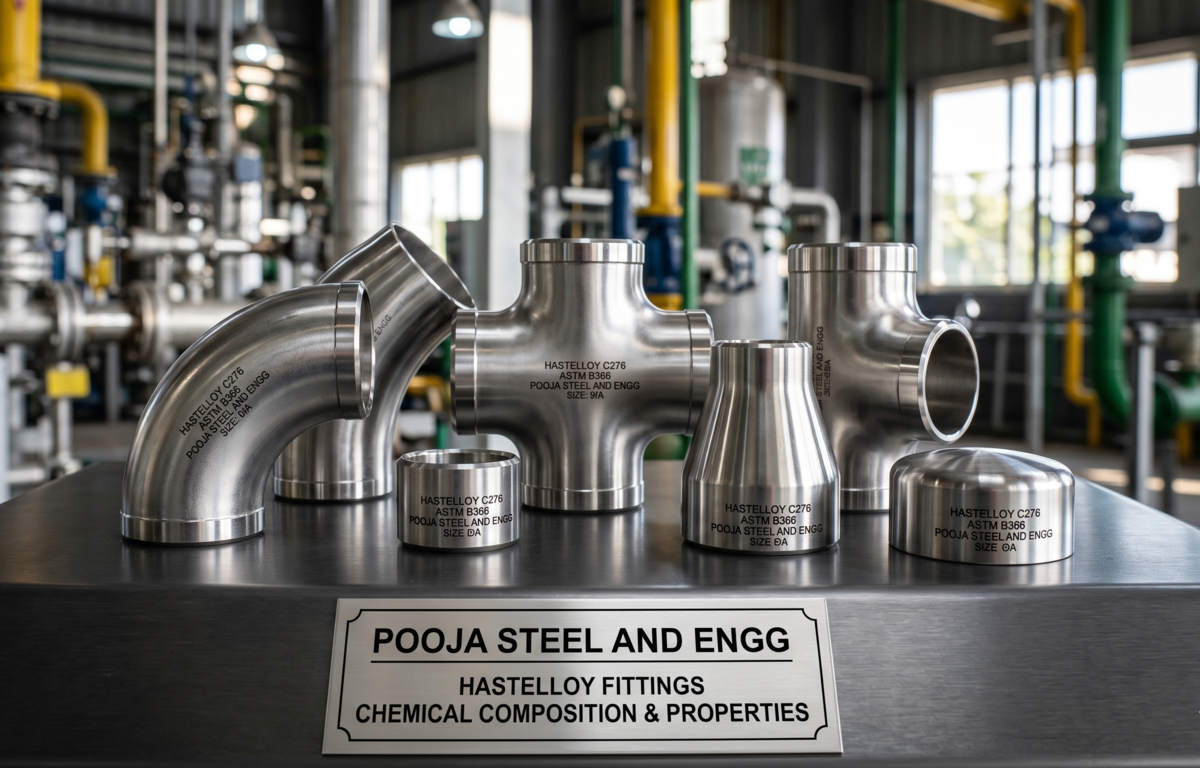
In the demanding world of industrial processing, where aggressive chemicals and extreme temperatures are the norm, standard stainless steel often falls short. For engineers and procurement specialists at Pooja Steel and Engg, finding materials that can withstand these 'hellish' environments is a top priority. This is where Hastelloy fittings become the undisputed champions. But what makes this nickel-based superalloy so resilient? The answer lies in its precise atomic recipe. In this blog, we explore the chemical composition and mechanical properties of Hastelloy fittings—specifically the widely used C276 and C22 grades. The Chemistry of Strength: Chemical Composition Hastelloy is primarily a nickel-molybdenum-chromium alloy. Each element is added with a specific purpose to combat various forms of corrosion. Element Role in Hastelloy Fittings Nickel (Ni) :- The base metal; provides excellent resistance to alkaline environments and stress corrosion cracking. Molybdenum (Mo) :- The primary defense against pitting and crevice corrosion, especially in chloride-rich environments. Chromium (Cr) :- Creates a protective oxide film that resists oxidizing media like wet chlorine and nitric acid. Tungsten (W) :- Added in grades like C276 to further enhance pitting resistance in severe conditions. Iron (Fe) :- Controlled at low levels to maintain structural integrity without compromising corrosion resistance. Typical Composition Table (Grade C276) • Nickel: 57% (Balance) • Molybdenum: 15% – 17% • Chromium: 14.5% – 16.5% • Iron: 4% – 7% • Tungsten: 3% – 4.5% Key Properties of Hastelloy Fittings Why should your next project at Pooja Steel and Engg utilize Hastelloy? Beyond the chemistry, the physical and mechanical properties speak for themselves. 1. Unmatched Corrosion Resistance Hastelloy fittings are famous for their 'universal' resistance. They can handle: • Strong Oxidizers: Ferric and cupric chlorides. • Hot Contaminated Media: Organic and inorganic acids. • Chlorine Gas: One of the few materials that can withstand wet chlorine gas. 2. Exceptional Thermal Stability Unlike many alloys that become brittle or lose strength at high temperatures, Hastelloy maintains its mechanical properties. This makes it ideal for heat exchangers and reactors that operate under intense heat. 3. High Tensile Strength Despite its focus on corrosion, Hastelloy is incredibly tough. • Tensile Strength: Approx. 790 MPa ($114, 500$ psi) • Yield Strength: Approx. 355 MPa ($51, 500$ psi) 4. Ease of Fabrication & Welding Even though it is a superalloy, Hastelloy fittings are designed for excellent weldability. Grades like C276 minimize the formation of grain-boundary precipitates in the weld-heat-affected zone, maintaining corrosion resistance even in the welded state. Why Source from Pooja Steel and Engg? At Pooja Steel and Engg, we understand that in the chemical, petrochemical, and pharmaceutical industries, there is zero room for error. A single failing fitting can lead to catastrophic leaks and expensive downtime. We supply a comprehensive range of Hastelloy fittings, including elbows, tees, reducers, and caps, all tested to meet stringent international standards (ASTM B366). Our products ensure that your piping systems are not just connected, but protected. Conclusion Understanding the chemical composition and properties of Hastelloy fittings is the first step in building a safer, more efficient industrial plant. By combining the corrosion-fighting power of Molybdenum and Chromium with the structural integrity of Nickel, these fittings offer a lifespan that far outlasts cheaper alternatives. Looking for a quote on Hastelloy C276 or C22 fittings? Contact Pooja Steel and Engg today for technical expertise and premium quality supplies that keep your operations running smoothly. Hastelloy Fittings Chemical Composition, Hastelloy Properties, Pooja Steel and Engg, Hastelloy C276 Fittings, Nickel-based Superalloy, ASTM B366, Corrosion Resistance.


This is your website preview.
Currently it only shows your basic business info. Start adding relevant business details such as description, images and products or services to gain your customers attention by using Boost 360 android app / iOS App / web portal.
Unlocking Superior Corrosion Resistance: A Deep Dive into Hastelloy Fittings Chemical Composition &
2026-04-21T04:29:29
In the demanding world of industrial processing, where aggressive chemicals and extreme temperatures are the norm, standard stainless steel often falls short. For engineers and procurement specialists at Pooja Steel and Engg, finding materials that can withstand these 'hellish' environments is a top priority. This is where Hastelloy fittings become the undisputed champions. But what makes this nickel-based superalloy so resilient? The answer lies in its precise atomic recipe. In this blog, we explore the chemical composition and mechanical properties of Hastelloy fittings—specifically the widely used C276 and C22 grades. The Chemistry of Strength: Chemical Composition Hastelloy is primarily a nickel-molybdenum-chromium alloy. Each element is added with a specific purpose to combat various forms of corrosion. Element Role in Hastelloy Fittings Nickel (Ni) :- The base metal; provides excellent resistance to alkaline environments and stress corrosion cracking. Molybdenum (Mo) :- The primary defense against pitting and crevice corrosion, especially in chloride-rich environments. Chromium (Cr) :- Creates a protective oxide film that resists oxidizing media like wet chlorine and nitric acid. Tungsten (W) :- Added in grades like C276 to further enhance pitting resistance in severe conditions. Iron (Fe) :- Controlled at low levels to maintain structural integrity without compromising corrosion resistance. Typical Composition Table (Grade C276) • Nickel: 57% (Balance) • Molybdenum: 15% – 17% • Chromium: 14.5% – 16.5% • Iron: 4% – 7% • Tungsten: 3% – 4.5% Key Properties of Hastelloy Fittings Why should your next project at Pooja Steel and Engg utilize Hastelloy? Beyond the chemistry, the physical and mechanical properties speak for themselves. 1. Unmatched Corrosion Resistance Hastelloy fittings are famous for their 'universal' resistance. They can handle: • Strong Oxidizers: Ferric and cupric chlorides. • Hot Contaminated Media: Organic and inorganic acids. • Chlorine Gas: One of the few materials that can withstand wet chlorine gas. 2. Exceptional Thermal Stability Unlike many alloys that become brittle or lose strength at high temperatures, Hastelloy maintains its mechanical properties. This makes it ideal for heat exchangers and reactors that operate under intense heat. 3. High Tensile Strength Despite its focus on corrosion, Hastelloy is incredibly tough. • Tensile Strength: Approx. 790 MPa ($114, 500$ psi) • Yield Strength: Approx. 355 MPa ($51, 500$ psi) 4. Ease of Fabrication & Welding Even though it is a superalloy, Hastelloy fittings are designed for excellent weldability. Grades like C276 minimize the formation of grain-boundary precipitates in the weld-heat-affected zone, maintaining corrosion resistance even in the welded state. Why Source from Pooja Steel and Engg? At Pooja Steel and Engg, we understand that in the chemical, petrochemical, and pharmaceutical industries, there is zero room for error. A single failing fitting can lead to catastrophic leaks and expensive downtime. We supply a comprehensive range of Hastelloy fittings, including elbows, tees, reducers, and caps, all tested to meet stringent international standards (ASTM B366). Our products ensure that your piping systems are not just connected, but protected. Conclusion Understanding the chemical composition and properties of Hastelloy fittings is the first step in building a safer, more efficient industrial plant. By combining the corrosion-fighting power of Molybdenum and Chromium with the structural integrity of Nickel, these fittings offer a lifespan that far outlasts cheaper alternatives. Looking for a quote on Hastelloy C276 or C22 fittings? Contact Pooja Steel and Engg today for technical expertise and premium quality supplies that keep your operations running smoothly. Hastelloy Fittings Chemical Composition, Hastelloy Properties, Pooja Steel and Engg, Hastelloy C276 Fittings, Nickel-based Superalloy, ASTM B366, Corrosion Resistance.
2026-04-21T04:29:29


Keywords
- Hastelloy C276 Price per kg in India
- Buy Hastelloy C22 Pipe Fittings Online
- Hastelloy Alloy Suppliers in Mumbai
- Hastelloy C276 Plate Stockist in India
- Request Quote for Hastelloy Fittings
- Hastelloy Round Bar Manufacturers in Gujarat
- Discounted Hastelloy C276 Sheet Prices
- Hastelloy Alloy B3 Export Price
- Authorized Hastelloy Suppliers for Oil & Gas
- Hastelloy C22 Flange Price List 2026
- ASTM B366 Hastelloy C276 Fittings
- Nickel Alloy C276 Pipe Fittings Manufacturer
- UNS N10276 Hastelloy Fittings Supplier
- Hastelloy C22 vs C276 for Chemical Plants
- Hastelloy B2/B3 Reducing Acid Service Fittings
- ASME SB366 Hastelloy Butt Weld Fittings
- Corrosion Resistant Hastelloy C276 Elbows
- High Pressure Hastelloy Forged Fittings Price
- Hastelloy C276 Concentric Reducer Dimensions
- Hastelloy X High Temperature Alloy Fittings
- Hastelloy Fittings Manufacturers near me
- Hastelloy Fittings Manufacturers near Vadodara
- Pooja Steel and Engg Hastelloy Catalog
- Hastelloy Pipe Fittings Exporters in India
- Industrial Grade Hastelloy Fittings Wholesale
- Hastelloy C276 Seamless Pipe Fittings Supplier
- Hastelloy C276 fittings composition
- Nickel-based superalloy corrosion resistance
- Hastelloy C22 ASTM B366 fittings
- Pooja Steel and Engg Hastelloy supply
- Hastelloy fittings for chlorides and acids
Submit Your Enquiry