
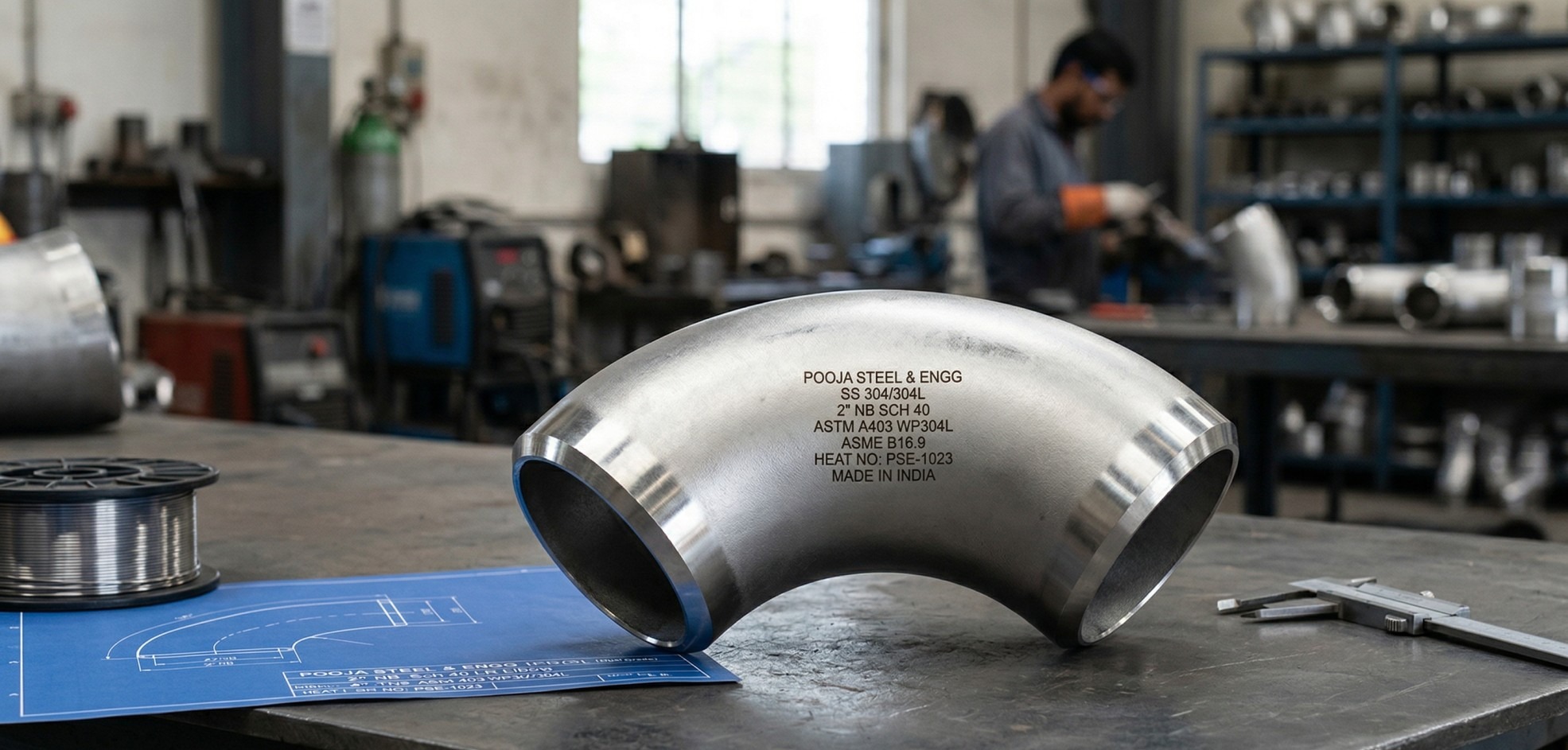
In the world of industrial piping, the SS 304/304L Elbow is more than just a directional fitting—it is a critical component that ensures the structural integrity and longevity of a system. Whether you are navigating a high-pressure chemical line or a sanitary food processing plant, choosing the right grade and radius is essential. At Pooja Steel and Engg, we specialize in high-performance buttweld fittings. In this guide, we break down everything you need to know about the 304/304L dual-grade elbow . 1. The 'L' Factor: Understanding 304 vs. 304L One of the most frequent questions we receive is: “Should I use 304 or 304L for my project?” • SS 304: The standard '18/8' stainless steel. It offers excellent strength and corrosion resistance but can be prone to 'sensitization' (carbide precipitation) during heavy welding. • SS 304L: The 'Low Carbon' version (max 0.03% carbon). This minor change makes a massive difference in weldability. It eliminates the risk of intergranular corrosion after welding, making it the industry standard for welded assemblies. The Pooja Steel Advantage: Most of our stock is Dual Certified (304/304L). This means you get the higher strength of 304 with the superior weldability of 304L in a single fitting. 2. Long Radius (LR) vs. Short Radius (SR) Elbows The 'radius' of your elbow determines how your fluid or gas moves through the bend. • 90 Degree Long Radius (1.5D): These are the most common. They provide a smooth flow with minimal pressure drop and internal friction. • 90 Degree Short Radius (1.0D): Used primarily in tight spaces where 'compactness' is more important than flow efficiency. 3. Key Applications of 304/304L Fittings Because of its versatility and cost-effectiveness, the SS 304 elbow is the 'workhorse' of several sectors: • Food & Dairy: Non-porous surfaces ensure hygiene and zero contamination. • Chemical Processing: Resists organic chemicals and moderately aggressive inorganic acids. • Water Treatment: Provides a 50+ year service life compared to PVC or galvanized iron. • Architectural: Used in handrails and structural frames due to its aesthetic 'mirror' or 'satin' finish. 4. Quality Checklist: What to Look for in a Supplier Don’t let a cheap fitting cause a million-dollar leak. When sourcing SS 304L elbows, always verify: 1. Material Test Certificates (MTC): Ensure the chemical composition (Chromium/Nickel) meets ASTM A403 standards. 2. Dimensional Accuracy: Fittings should comply with ASME B16.9 for a perfect weld fit-up. 3. Surface Finish: High-quality elbows should be free of cracks, pits, or deep scratches. Conclusion Selecting the right SS 304/304L elbow is a balance of metallurgy, geometry, and budget. At Pooja Steel and Engg, we combine technical expertise with a vast inventory of seamless and welded elbows to keep your projects moving. Need a price list or a technical consultation? Contact Pooja Steel and Engg today for a custom quote on your next piping requirement! SS 304/304L Elbow 90 Degree SS Elbow Manufacturer ASTM A403 WP304L Fittings Stainless Steel 304L Buttweld Elbow Price Long Radius vs Short Radius Elbow. Discover why SS 304/304L dual-grade elbows are the best choice for your piping system. Learn about 304L weldability, LR vs SR radius, and industry applications from Pooja Steel and Engg.


This is your website preview.
Currently it only shows your basic business info. Start adding relevant business details such as description, images and products or services to gain your customers attention by using Boost 360 android app / iOS App / web portal.
Why SS 304/304L Elbows are the Backbone of Modern Piping Systems
2026-03-28T05:04:37
In the world of industrial piping, the SS 304/304L Elbow is more than just a directional fitting—it is a critical component that ensures the structural integrity and longevity of a system. Whether you are navigating a high-pressure chemical line or a sanitary food processing plant, choosing the right grade and radius is essential. At Pooja Steel and Engg, we specialize in high-performance buttweld fittings. In this guide, we break down everything you need to know about the 304/304L dual-grade elbow . 1. The 'L' Factor: Understanding 304 vs. 304L One of the most frequent questions we receive is: “Should I use 304 or 304L for my project?” • SS 304: The standard '18/8' stainless steel. It offers excellent strength and corrosion resistance but can be prone to 'sensitization' (carbide precipitation) during heavy welding. • SS 304L: The 'Low Carbon' version (max 0.03% carbon). This minor change makes a massive difference in weldability. It eliminates the risk of intergranular corrosion after welding, making it the industry standard for welded assemblies. The Pooja Steel Advantage: Most of our stock is Dual Certified (304/304L). This means you get the higher strength of 304 with the superior weldability of 304L in a single fitting. 2. Long Radius (LR) vs. Short Radius (SR) Elbows The 'radius' of your elbow determines how your fluid or gas moves through the bend. • 90 Degree Long Radius (1.5D): These are the most common. They provide a smooth flow with minimal pressure drop and internal friction. • 90 Degree Short Radius (1.0D): Used primarily in tight spaces where 'compactness' is more important than flow efficiency. 3. Key Applications of 304/304L Fittings Because of its versatility and cost-effectiveness, the SS 304 elbow is the 'workhorse' of several sectors: • Food & Dairy: Non-porous surfaces ensure hygiene and zero contamination. • Chemical Processing: Resists organic chemicals and moderately aggressive inorganic acids. • Water Treatment: Provides a 50+ year service life compared to PVC or galvanized iron. • Architectural: Used in handrails and structural frames due to its aesthetic 'mirror' or 'satin' finish. 4. Quality Checklist: What to Look for in a Supplier Don’t let a cheap fitting cause a million-dollar leak. When sourcing SS 304L elbows, always verify: 1. Material Test Certificates (MTC): Ensure the chemical composition (Chromium/Nickel) meets ASTM A403 standards. 2. Dimensional Accuracy: Fittings should comply with ASME B16.9 for a perfect weld fit-up. 3. Surface Finish: High-quality elbows should be free of cracks, pits, or deep scratches. Conclusion Selecting the right SS 304/304L elbow is a balance of metallurgy, geometry, and budget. At Pooja Steel and Engg, we combine technical expertise with a vast inventory of seamless and welded elbows to keep your projects moving. Need a price list or a technical consultation? Contact Pooja Steel and Engg today for a custom quote on your next piping requirement! SS 304/304L Elbow 90 Degree SS Elbow Manufacturer ASTM A403 WP304L Fittings Stainless Steel 304L Buttweld Elbow Price Long Radius vs Short Radius Elbow. Discover why SS 304/304L dual-grade elbows are the best choice for your piping system. Learn about 304L weldability, LR vs SR radius, and industry applications from Pooja Steel and Engg.
2026-03-28T05:04:37


Submit Your Enquiry